Potassium Hydroxide → 1-(2-Hydroxyphenyl)-3-(1H-indol-4-yl)prop-2-en-1-one
Reaction equation

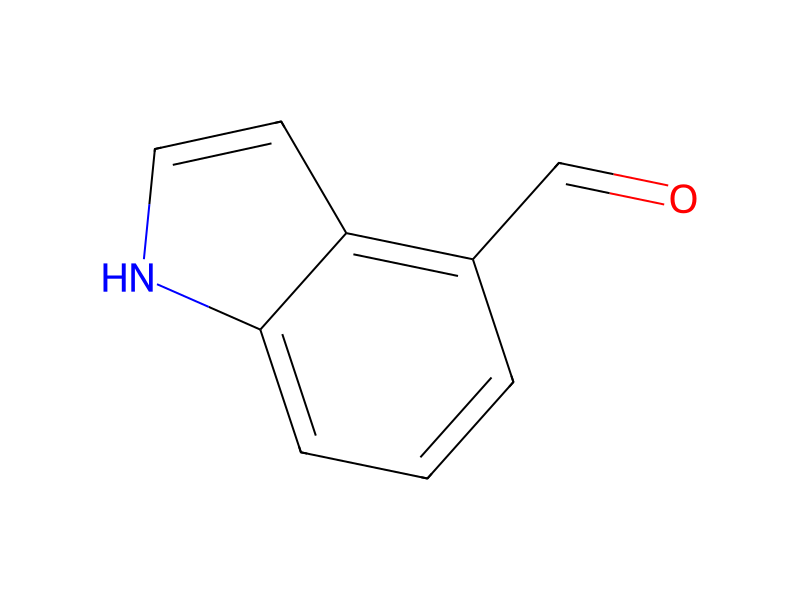
[OH-:1].[K+].[NH:3]1[C:11]2[CH:10]=[CH:9][CH:8]=[C:7]([CH:12]=O)[C:6]=2[CH:5]=[CH:4]1.O[CH2:15][C:16]([C:18]1[CH:23]=[CH:22][CH:21]=[CH:20][CH:19]=1)=[O:17].C([N+](CC)(CC)CC1C=CC=CC=1)C>C(O)C.O>[OH:1][C:19]1[CH:20]=[CH:21][CH:22]=[CH:23][C:18]=1[C:16](=[O:17])[CH:15]=[CH:12][C:7]1[CH:8]=[CH:9][CH:10]=[C:11]2[C:6]=1[CH:5]=[CH:4][NH:3]2Participants
7






Conditions
- Temperature
- 30 °C
Procedure
0.5 ml of 38% potassium hydroxide solution was added with stirring under an inert atmosphere at 30° C. to a mixture of 0.132 g of indole-4-carboxaldehyde, 0.1 ml of 2-hydroxy-acetophenone and 0.189 g of triethylbenzylammonium in 2 ml of ethanol and after stirring at 30° C. for 23 hours, the mixture was diluted with water and extracted with ethyl acetate. The organic phase was washed with water, dried and evaporated to dryness under reduced pressure. The residue was chromatographed over silica and eluted with methylene chloride to obtain 159 mg of 1-(2-hydroxyphenyl)-3-(1H-indol-4-yl)-2-propen-1-one melting 164° C.
Workup
- extractionextracted with ethyl acetate
- washThe organic phase was washed with water
- customdried
- customevaporated to dryness under reduced pressure
- customThe residue was chromatographed over silica
- washeluted with methylene chloride
Sources & evidence
- ORD record
- ord-e9adc636d8a742e89eadb4d6d6fa0517
- Source dataset
- uspto-grants-1989_02
- Patent number
- US04808609
Reaction notes
Loading…