Water → 4-Ethynylphenol
Reaction equation

[CH:1]([C:3]1[CH:8]=[CH:7][C:6]([OH:9])=[CH:5][CH:4]=1)=[CH2:2].C(#N)C.O.C1(C)C=CC=CC=1>CC(C)=O.CCCCCC>[CH:2]#[C:1][C:3]1[CH:8]=[CH:7][C:6]([OH:9])=[CH:5][CH:4]=1Participants
Reactant 4



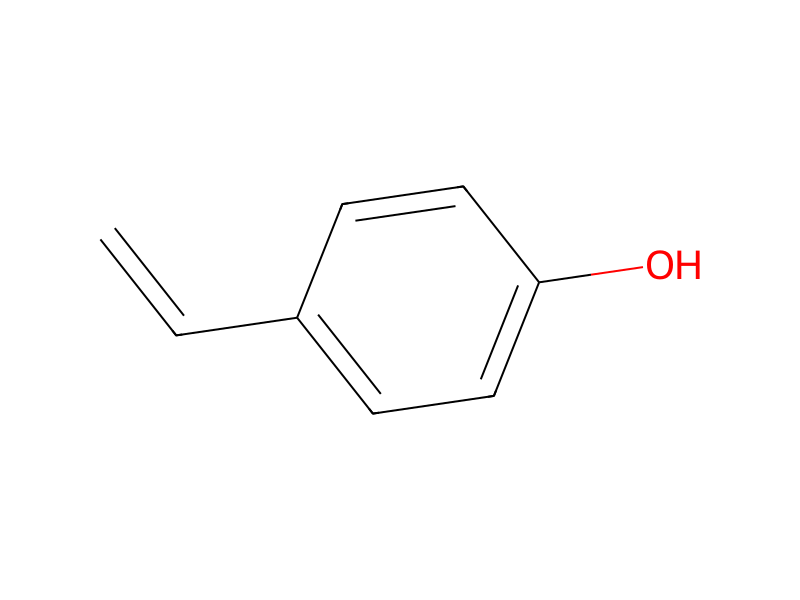
Product 1

Reagents, catalysts & solvents 2


Conditions
- Temperature
- 30 °C
Procedure
32.1 g of the p-vinylphenol-containing fraction as a polymerization raw material was poured into a 300-ml flask. Thereto was added 29.4 g of acetonitrile. The resulting mixture was stirred with cooling by water of room temperature. Thereto was dropwise added 1.0 ml of an acetonitrile solution of 2% of a boron trifluoride-diethyl ether complex. Then, a polymerization reaction was conducted for 30 minutes. During the period, the temperature of the reaction system was maintained at 25 to 35° C. The reaction mixture was poured into 300 ml of toluene, followed by stirring. The resulting precipitate was recovered. The precipitate was dissolved again in 50 ml of acetone. The resulting solution was poured into 300 ml of toluene to form a precipitate. This precipitate was dissolved in 50 ml of acetone. The resulting solution was poured into 300 ml of hexane for reprecipitation. The thus-purified polymer was dried under vacuum to obtain 5.6 g of a white poly(p-vinylphenol). The poly(p-vinylphenol) had a weight-average molecular weight (Mw) of 29,200, a number-average molecular weight (Mn) of 14,300, a far-ultraviolet light transmittance at a wavelength of 248 nm (sample concentration: 0.1 g per liter of ethanol solution, cell length: 1 cm) of 79.4% (the far-ultraviolet light transmittance is hereinafter abbreviated as light transmittance), a light transmittance at a wavelength of 450 nm (sample concentration. 1.0 g per liter of ethanol solution, cell length: 10 cm) of 96.1%, and a glass transition temperature of 182° C. Incidentally, the w/Mn as an indicator of molecular weight distribution was 2.04.
Workup
- customas a polymerization raw material
- additionwas poured into a 300-ml flask
- customThen, a polymerization reaction
- stirringby stirring
- customThe resulting precipitate was recovered
- dissolutionThe precipitate was dissolved again in 50 ml of acetone
- additionThe resulting solution was poured into 300 ml of toluene
- customto form a precipitate
- customThe thus-purified polymer was dried under vacuum
Sources & evidence
- ORD record
- ord-34a5a07597fe49eabed6f262d777e8c6
- Source dataset
- uspto-grants-2001_07
- Patent number
- US06258901B1
Reaction notes
Loading…