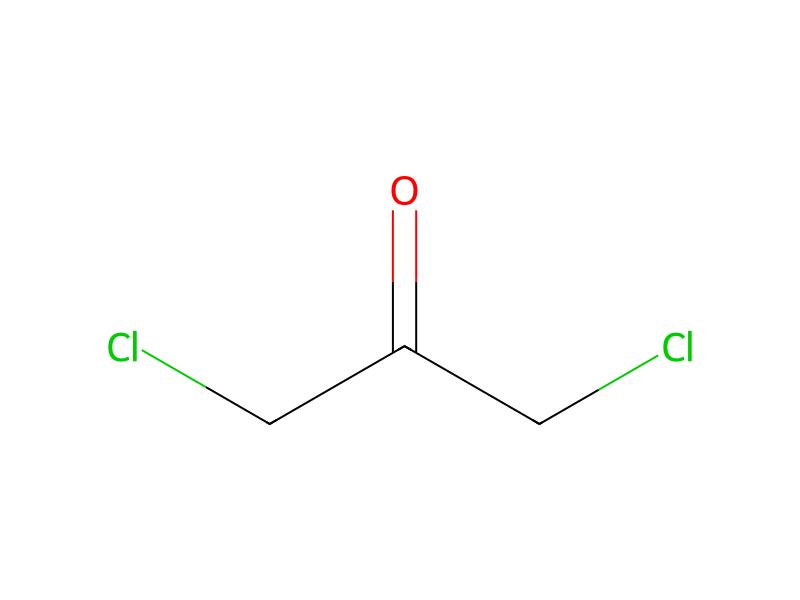
1,3-Dichloroacetone → 4-(Chloromethyl)-2-(3,4-dichlorophenyl)-1,3-thiazole
Reaction equation

[Cl:1][C:2]1[CH:3]=[C:4]([CH:8]=[CH:9][C:10]=1[Cl:11])[C:5]([NH2:7])=[S:6].[Cl:12][CH2:13][C:14]([CH2:16]Cl)=O>CC(C)=O>[Cl:12][CH2:13][C:14]1[N:7]=[C:5]([C:4]2[CH:8]=[CH:9][C:10]([Cl:11])=[C:2]([Cl:1])[CH:3]=2)[S:6][CH:16]=1Participants
4
Reactant 2

Product 1

Reagents, catalysts & solvents 1

Procedure
A mixture of 3,4-dichlorothiobenzamide (8.24 g., 0.04 mol), 1,3-dichloroacetone (5.1 g., 0.04 mol) in acetone (150 ml) was stirred at room temperature overnight. After evaporation of the acetone under reduced pressure, the residue was dissolved in methanol (150 ml) and the solution refluxed 11/2 hours. After cooling and removal of the methanol, the residue was slurried with a small quantity of methanol. The solids which formed after filtration showed m.p. 93°-96° C. (6.05 g.).
Workup
- customAfter evaporation of the acetone under reduced pressure
- dissolutionthe residue was dissolved in methanol (150 ml)
- temperaturethe solution refluxed 11/2 hours
- temperatureAfter cooling
- customremoval of the methanol
- customThe solids which formed
- filtrationafter filtration
Sources & evidence
- ORD record
- ord-b4c7d1242fc44590aa78f89654b9bfb5
- Source dataset
- uspto-grants-1984_02
- Patent number
- US04431652
Reaction notes
Loading…