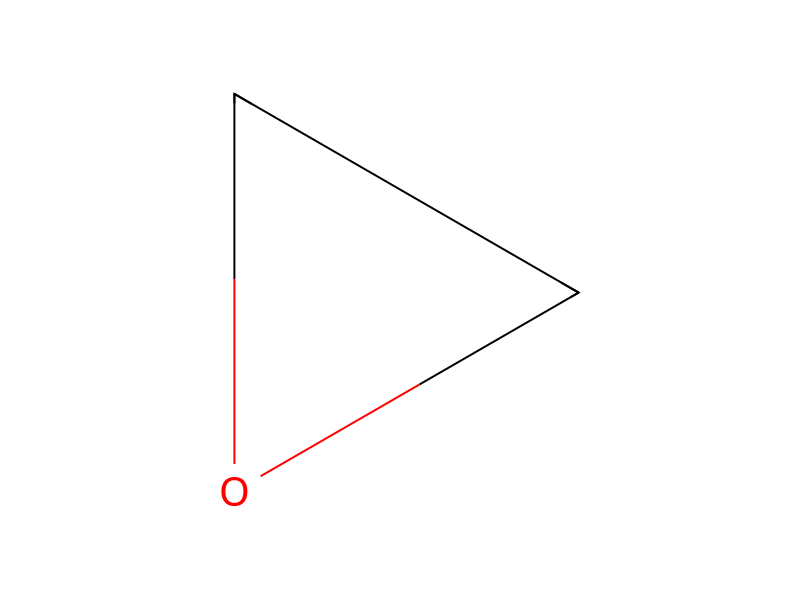
Ethylene Oxide → HCID 197116, compound
Reaction equation

[C:1]([O:6][CH2:7]C(O)C)(=[O:5])[C:2]([CH3:4])=[CH2:3].C1OC1.OC1C=CC(C(C2C=CC(O)=CC=2)(C)C)=CC=1>>[CH3:4][C:2]([C:1]([O-:6])=[O:5])=[CH2:3].[CH3:4][C:2]([C:1]([O:6][CH3:7])=[O:5])=[CH2:3]Participants


Procedure
To a mixture of 50 parts of 2-hydroxypropyl methacrylate and 50 parts of dimethacrylate of a 2.6 mol-ethylene oxide adduct (an average addition amount) of Bisphenol A (NK ester BPE 2.6 produced by Shin-nakamura Kagaku Kogyo K.K., Japan, hereinafter referred to as BPE 2.6) was added 7.5 parts of an acrylic polymer having a polymerization degree of about 1,000 and a molecular weight of about 100,000 (DIANAL BR 75 produced by Mitsubishi Rayon K.K., Japan). The mixture was dissolved by heating at 80° C. for 2 hours. Thereto were then added 1.5 parts of SQ salt obtained in Reference example. The resulting mixture was dissolved by heating for 10 minutes, cooled to room temperature, then incorporated with 0.5 part of cumene hydroperoxide and 1.5 parts of water, and dissolved with stirring. To the resulting systems were added 0.1 part each of various polymerizable phosphates. Properties of the resulting composition were determined and shown in Table 1. Incidentally, the measurements of properties were conducted by the following methods.
Workup
- customproduced by Shin-nakamura Kagaku Kogyo K.K
Sources & evidence
- ORD record
- ord-89bcff9566ad42e698fe621356e7fe8c
- Source dataset
- uspto-grants-1984_02
- Patent number
- US04433124
Reaction notes
Loading…