2-Chloro-6,7-dimethoxy-4-quinazolinamine → HCID 131712025, compound
Reaction equation

[NH2:1][C:2]1[C:11]2[C:6](=[CH:7][C:8]([O:14][CH3:15])=[C:9]([O:12][CH3:13])[CH:10]=2)[N:5]=[C:4]([Cl:16])[N:3]=1.Cl.[NH:18]1[CH2:23][CH2:22][CH:21]([CH2:24][CH2:25][C:26]([OH:28])=[O:27])[CH2:20][CH2:19]1>C(O)CCC>[ClH:16].[NH2:1][C:2]1[C:11]2[C:6](=[CH:7][C:8]([O:14][CH3:15])=[C:9]([O:12][CH3:13])[CH:10]=2)[N:5]=[C:4]([N:18]2[CH2:23][CH2:22][CH:21]([CH2:24][CH2:25][C:26]([O:28][CH2:11][CH2:6][CH2:7][CH3:8])=[O:27])[CH2:20][CH2:19]2)[N:3]=1Participants
4
Reactant 2
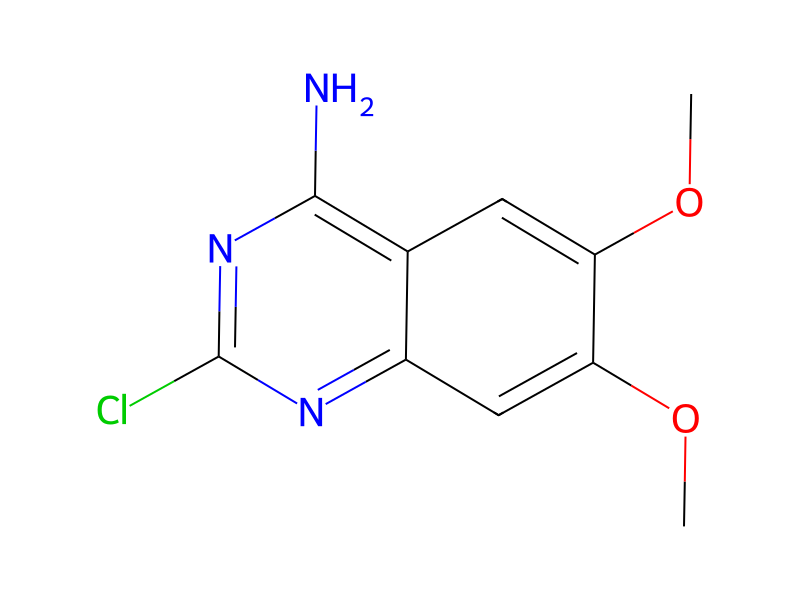

Product 1

Reagents, catalysts & solvents 1

Procedure
4-Amino-2-chloro-6,7-dimethoxyquinazoline (24.9 g) and 3-(4-piperidinyl)propionic acid, hydrochloride (20 g) in n-butanol (1000 ml) were stirred under reflux for 20 hours. The hot suspension was filtered and the insoluble material discarded. The filtrate was cooled in ice/water, the precipitated solid collected and the filtrate evaporated in vacuo. The resulting solid and the precipitated solid were combined and crystallised from isopropanol to give 4-amino-2-[4-(2-{n-butoxycarbonyl}ethyl)piperidino]-6,7-dimethoxyquinazoline, hydrochloride (27.0 g) with m.p. 250°-252°.
Workup
- temperatureunder reflux for 20 hours
- filtrationThe hot suspension was filtered
- temperatureThe filtrate was cooled in ice/water
- customthe precipitated solid collected
- customthe filtrate evaporated in vacuo
- customcrystallised from isopropanol
Sources & evidence
- ORD record
- ord-741510022d514c349793c795e552878b
- Source dataset
- uspto-grants-1981_01
- Patent number
- US04243666
Reaction notes
Loading…