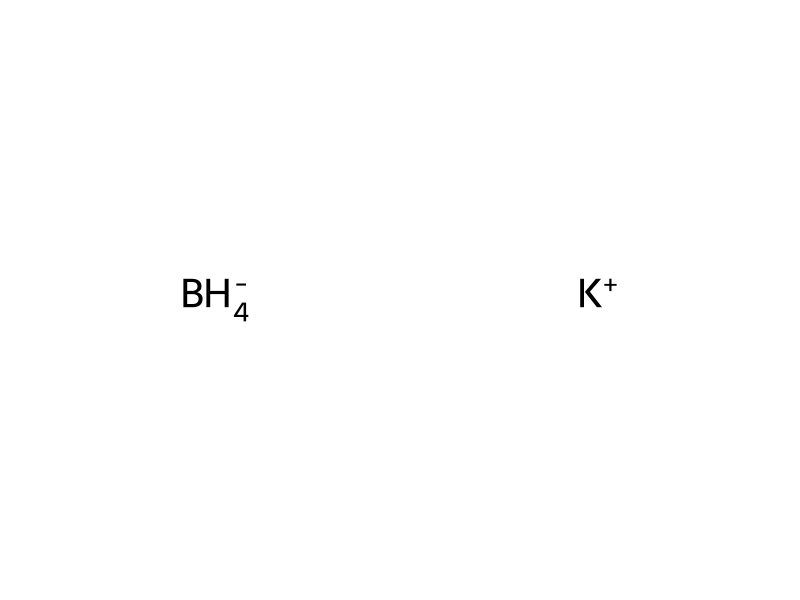
Potassium borohydride → alpha-(1-Naphthyl)-4-piperidinemethanol
Reaction equation

Cl.[NH:2]1[CH2:7][CH2:6][CH:5]([C:8]([C:10]2[C:19]3[C:14](=[CH:15][CH:16]=[CH:17][CH:18]=3)[CH:13]=[CH:12][CH:11]=2)=[O:9])[CH2:4][CH2:3]1.[BH4-].[K+]>CO>[C:10]1([CH:8]([CH:5]2[CH2:6][CH2:7][NH:2][CH2:3][CH2:4]2)[OH:9])[C:19]2[C:14](=[CH:15][CH:16]=[CH:17][CH:18]=2)[CH:13]=[CH:12][CH:11]=1Participants
4
Reactant 2

Product 1

Reagents, catalysts & solvents 1

Procedure
To a solution of 60 g (0.22 mole) of 1-naphthyl 4-piperidyl ketone hydrochloride in 500 ml of methanol, 35 g (0.65 mole) of potassium borohydride is added gradually while stirred in an ice bath and the mixture reacted for 18 hours. The mixture is concentrated in vacuo, the residue partitioned between chloroform and water, and the organic phase dried over magnesium sulfate, filtered and the solvent removed in vacuo to yield α-(1-naphthyl)-4-piperidinemethanol, which is dissolved in chloroform and an excess of dry HCl bubbled into the solution. The resulting precipitate is recrystallized from methanol/butanone to yield α-(1-naphthyl)-4-piperidinemethanol hydrochloride. M.P. 219°-21°.
Workup
- customthe mixture reacted for 18 hours
- concentrationThe mixture is concentrated in vacuo
- customthe residue partitioned between chloroform and water
- dry with materialthe organic phase dried over magnesium sulfate
- filtrationfiltered
- customthe solvent removed in vacuo
Sources & evidence
- ORD record
- ord-84599ad969f54bf0b7b9064d30ac9cad
- Source dataset
- uspto-grants-1981_01
- Patent number
- US04246268
Reaction notes
Loading…