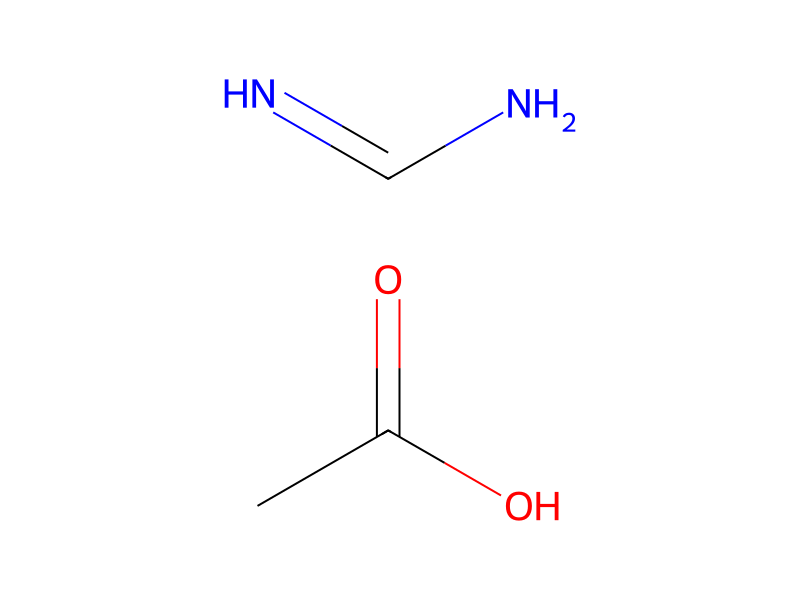
Formamidine acetate → 5-Chloropyrimidine-4-carboxylic acid
Reaction equation

C[O-].[Na+].[C:4]([OH:12])(=[O:11])/[C:5](=[C:7](\[CH:9]=O)/[Cl:8])/Cl.C(O)(=O)C.[CH:17]([NH2:19])=[NH:18]>CO>[C:4]([C:5]1[C:7]([Cl:8])=[CH:9][N:19]=[CH:17][N:18]=1)([OH:12])=[O:11]Participants
Reactant 3


Product 1

Reagents, catalysts & solvents 1

Procedure
Sodium methoxide (162 g) is added to a solution of mucochloric acid (169 g) and formamidine acetate (208 g) in methanol (3 liters) over the course of 20 minutes, and the reaction mixture is heated for 1 hour at 35°-40° C., and then for one and a half hours under reflux. The solvent is removed and water (500 cc) is added to the residue. The aqueous mixture is extracted with ethyl acetate (2 liters). The aqueous phase is brought to pH 1 by the addition of concentrated hydrochloric acid, and the aqueous phase is extracted with ethyl acetate (5 liters). The organic phase is dried over anhydrous magnesium sulphate, filtered and then concentrated to dryness. The residue is washed with diethyl ether (300 cc) and then with diisopropyl ether (600 cc). 4-Carboxy-5-chloropyrimidine (55.6 g), melting at 190° C., is obtained.
Workup
- temperaturethe reaction mixture is heated for 1 hour at 35°-40° C.
- temperaturefor one and a half hours under reflux
- customThe solvent is removed
- additionwater (500 cc) is added to the residue
- extractionThe aqueous mixture is extracted with ethyl acetate (2 liters)
- additionThe aqueous phase is brought to pH 1 by the addition of concentrated hydrochloric acid
- extractionthe aqueous phase is extracted with ethyl acetate (5 liters)
- dry with materialThe organic phase is dried over anhydrous magnesium sulphate
- filtrationfiltered
- concentrationconcentrated to dryness
- washThe residue is washed with diethyl ether (300 cc)
Sources & evidence
- ORD record
- ord-c455bc81688046a1b3fd7ae7f5ba20ae
- Source dataset
- uspto-grants-1979_02
- Patent number
- US04138487
Reaction notes
Loading…