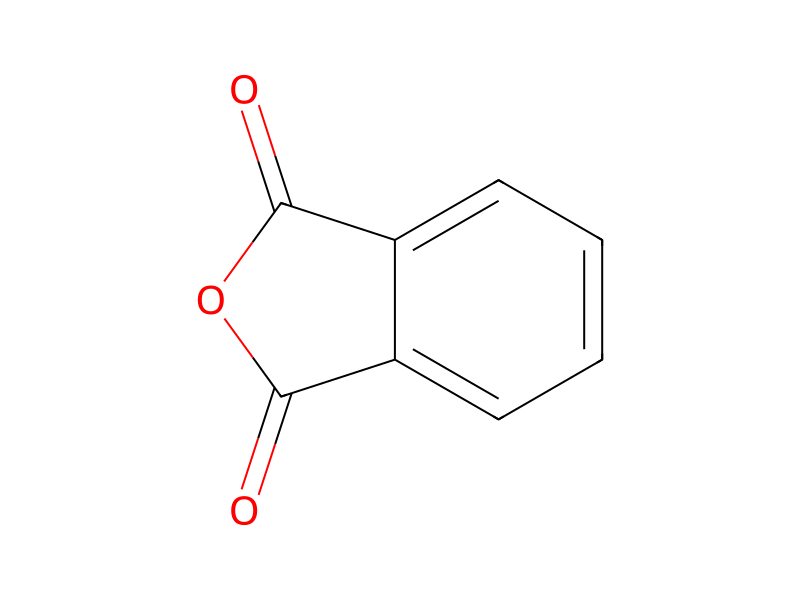
Phthalic Anhydride → Phthalic Acid
Reaction equation

[C:1]1(=[O:11])[O:6][C:4](=[O:5])[C:3]2=[CH:7][CH:8]=[CH:9][CH:10]=[C:2]12.[CH:12]1[CH:13]=[CH:14][C:15]2[C:22](=[O:23])[CH:21]=[CH:20][C:18](=[O:19])[C:16]=2[CH:17]=1>>[CH:13]1[CH:12]=[CH:17][C:16]2[C:18](=[O:19])[CH:20]=[CH:21][C:22](=[O:23])[C:15]=2[CH:14]=1.[C:1]([OH:6])(=[O:11])[C:2]1[C:3](=[CH:7][CH:8]=[CH:9][CH:10]=1)[C:4]([OH:19])=[O:5]Participants
4


Conditions
- Temperature
- 180 °C
Procedure
A reaction mixture gas containing 5.0 wt. parts of phthalic anhydride and 2.4 wt. parts of naphthoquinone which was formed by a catalytic vapor phase oxidation, was cooled to 180° C. by a gas cooler and was introduced into the mother liquor (pH of 1.9) to obtain an aqueous slurry of naphthoquinone and phthalic acid. The slurry (pH 1.7) was heated to 85° C. to dissolve all of phthalic acid. Naphthoquinone was extracted from the slurry of naphthoquinone in a counter-current extraction with 8.0 wt. parts of xylene. The xylene phase was washed with hot water and concentrated and dried at 70° C. under a vacuum of 60 Torr to obtain 2.4 wt. parts of naphthoquinone having a purity of 96.7%.
Workup
- customwas formed by a catalytic vapor phase oxidation
- additionwas introduced into the mother liquor (pH of 1.9)
Sources & evidence
- ORD record
- ord-f4639438e2c04d349e8884a56efb8aec
- Source dataset
- uspto-grants-1980_05
- Patent number
- US04202828
Reaction notes
Loading…