Chloranil → 4-(1,2,4,5-Tetrazin-3-yl)aniline
Reaction equation

Cl.Cl.[NH2:3][C:4]1[CH:12]=[CH:11][C:7]([C:8]([NH2:10])=[NH:9])=[CH:6][CH:5]=1.C(O)(=O)C.[CH:17]([NH2:19])=[NH:18].NN.ClC1C(=O)C(Cl)=C(Cl)C(=O)C=1Cl>C(#N)C>[N:18]1[CH:17]=[N:19][N:10]=[C:8]([C:7]2[CH:11]=[CH:12][C:4]([NH2:3])=[CH:5][CH:6]=2)[N:9]=1Participants
Reactant 4



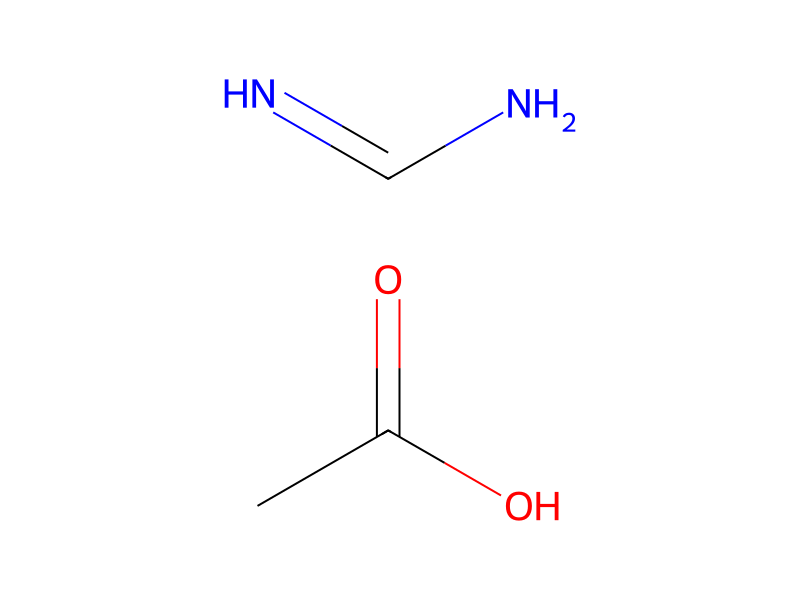
Product 1

Reagents, catalysts & solvents 1

Procedure
To a mixture of 4-Aminobenzamidine dihydrochloride (1 mmol, 208 mg) and formamidine acetate (4 mmol, 416 mg) in acetonitrile (25 mL) was added anhydrous hydrazine (10 mmol, 315 uL). The solution was heated to reflux for 1 hour, cooled, and the solvent was removed by rotary evaporation. The residue was resuspended with water (25 mL) and was stirred with solid tetrachloro-1,4-benzoquinone (2 mmol, 492 mg) for 1 hour. After removal of the solids from the pink solution by filtration, the reaction was concentrated by rotary evaporation and purified by preparative HPLC using a gradient from 0-40% buffer B (buffer A is water with 0.1% TFA, and buffer B is acetonitrile with 10% water and 0.1% TFA) to afford pure 4-(1,2,4,5-tetrazin-3-yl)aniline (33 mg, 19%), as a pink solid. LRMS-ESI [M+H]+ calcd. for C8H8N5+: 174.08, found: 173.9.
Workup
- temperatureThe solution was heated
- temperatureto reflux for 1 hour
- temperaturecooled
- customthe solvent was removed by rotary evaporation
- customAfter removal of the solids from the pink solution
- filtrationby filtration
- concentrationthe reaction was concentrated by rotary evaporation
- custompurified by preparative HPLC
Sources & evidence
- ORD record
- ord-7bec7a2f31474e1095b1fd8fd25a7756
- Source dataset
- uspto-grants-2014_12
- Patent number
- US08900549B2
Reaction notes
Loading…