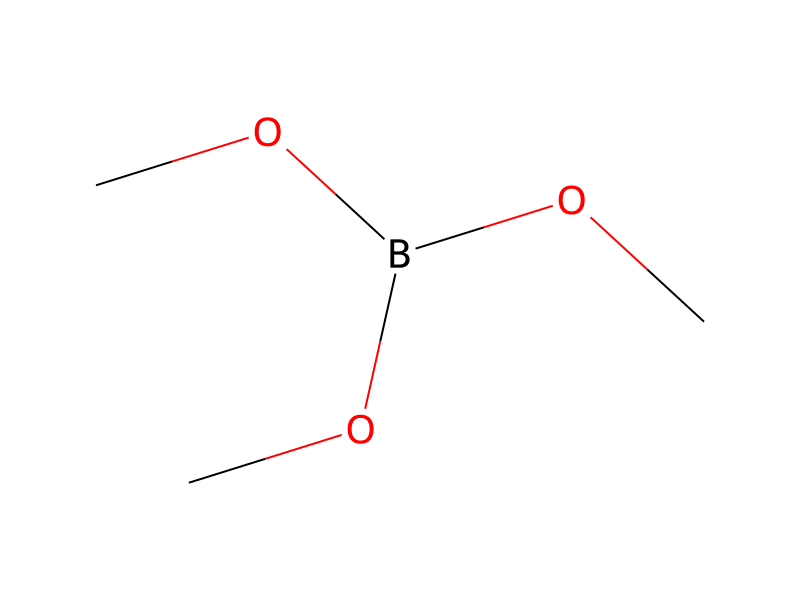
Trimethyl borate → Dimethyl 4-chloro-2-fluoro-3-methoxyphenylboronate
Reaction equation

[Cl:1][C:2]1[C:7]([O:8][CH3:9])=[C:6]([F:10])[C:5]([Li])=[CH:4][CH:3]=1.[B:12](OC)([O:15][CH3:16])[O:13][CH3:14]>>[Cl:1][C:2]1[CH:3]=[CH:4][C:5]([B:12]([O:15][CH3:16])[O:13][CH3:14])=[C:6]([F:10])[C:7]=1[O:8][CH3:9]Participants


Procedure
Another embodiment of the present disclosure includes a method of forming 2-(4-chloro-2-fluro-3-methoxylphenyl)-4,4,5,5-tetramethyl-1,3,2-dioxaborolane that comprises contacting 2-chloro-6-fluoroanisole with n-butyl lithium to form 6-chloro-2-fluoro-3-lithioanisole. The 6-chloro-2-fluoro-3-lithioanisole may be contacted with trimethyl borate to form dimethyl 4-chloro-2-fluoro-3-methoxyphenylboronate. The dimethyl 4-chloro-2-fluoro-3-methoxyphenylboronate may be reacted with aqueous potassium hydroxide to form potassium (4-chloro-2-fluoro-3-methoxyphenyl)trihydroxyborate. The potassium (4-chloro-2-fluoro-3-methoxyphenyl)trihydroxyborate then may be reacted with aqueous hydrochloric acid to form 4-chloro-2-fluoro-3-methoxyphenylboronic acid. The 4-chloro-2-fluoro-3-methoxyphenylboronic acid may be reacted with 2,3-dimethyl-2,3-butanediol.
Sources & evidence
- ORD record
- ord-24d9f639f70440aaa909120cd6276c19
- Source dataset
- uspto-grants-2014_12
- Patent number
- US08912339B2
Reaction notes
Loading…