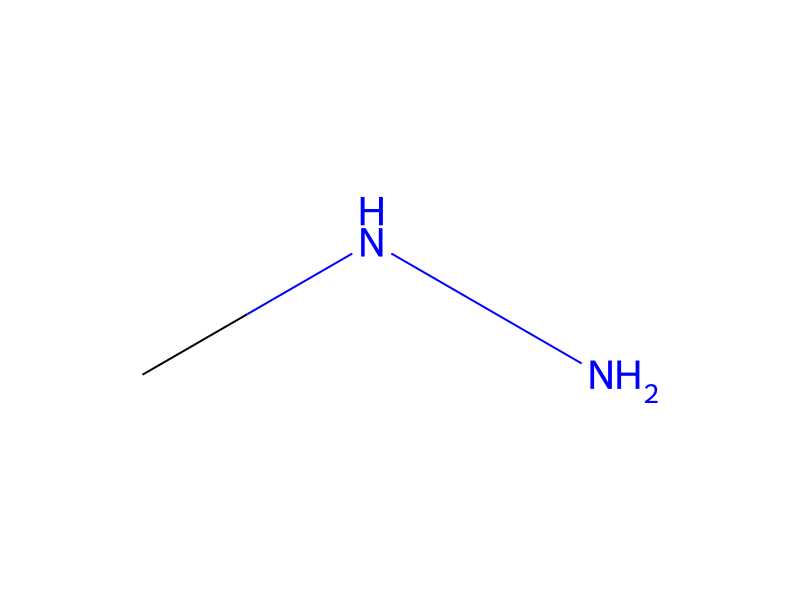
Methylhydrazine → HCID 21484120, compound
Reaction equation

[Cl:1][C:2]1[C:3](=[O:20])[N:4]([C:9]2[CH:14]=[C:13]([C:15]([F:18])([F:17])[F:16])[CH:12]=[CH:11][C:10]=2[F:19])[N:5]=[CH:6][C:7]=1Cl.[CH3:21][NH:22][NH2:23]>CO>[Cl:1][C:2]1[C:3](=[O:20])[N:4]([C:9]2[CH:14]=[C:13]([C:15]([F:18])([F:17])[F:16])[CH:12]=[CH:11][C:10]=2[F:19])[N:5]=[CH:6][C:7]=1[N:22]([CH3:21])[NH2:23]Participants
4
Reactant 2

Product 1

Reagents, catalysts & solvents 1

Procedure
To a solution of 41.8 grams of 4,5-dichloro-2-(2-fluoro-5-trifluoromethylphenyl)-pyridazin-3(2H)-one in 400 grams of methanol cooled to 15° C is added dropwise 18.4 grams of methylhydrazine. The reaction mixture is stirred at room temperature for 4 hours, and evaporated to dryness below 30° C. The resulting precipitate is dissolved in 300 grams of methylene dichloride and washed with 300 grams of water. The organic phase is separated and evaporated to dryness. The solid is crystallized from methanol to yield the title compound, m.p. 128° to 130° C (decomposition).
Workup
- customevaporated to dryness below 30° C
- dissolutionThe resulting precipitate is dissolved in 300 grams of methylene dichloride
- washwashed with 300 grams of water
- customThe organic phase is separated
- customevaporated to dryness
- customThe solid is crystallized from methanol
Sources & evidence
- ORD record
- ord-fa34b16539a54e73a0269036989edf01
- Source dataset
- uspto-grants-1977_01
- Patent number
- US04002751
Reaction notes
Loading…