Isovaleryl chloride → HCID 68144173, compound
Reaction equation

[CH2:1]([C@:3]12[CH2:11][CH2:10][C@@H:9]3[C@@H:12]4[C:17]([CH2:18][CH2:19][C@H:8]3[C@@H:7]1[CH2:6][CH2:5][C@@H:4]2[OH:21])=[CH:16][C:15](=[O:20])[CH2:14][CH2:13]4)[CH3:2].[C:22](Cl)(=[O:27])[CH2:23][CH:24]([CH3:26])[CH3:25]>N1C=CC=CC=1>[CH2:1]([C@:3]12[CH2:11][CH2:10][C@@H:9]3[C@@H:12]4[C:17]([CH2:18][CH2:19][C@H:8]3[C@@H:7]1[CH2:6][CH2:5][C@@H:4]2[O:21][C:22](=[O:27])[CH2:23][CH:24]([CH3:26])[CH3:25])=[CH:16][C:15](=[O:20])[CH2:14][CH2:13]4)[CH3:2]Participants
4
Reactant 2

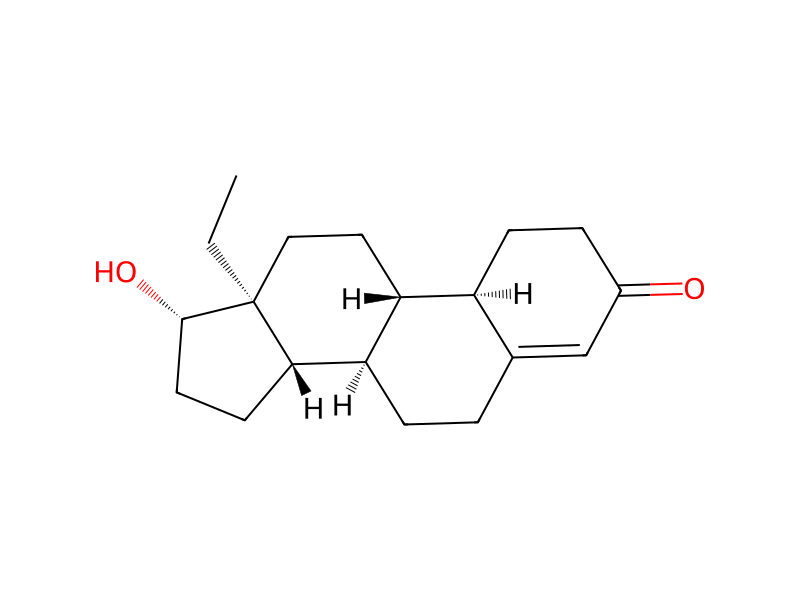
Product 1

Reagents, catalysts & solvents 1

Procedure
Keep 13β-ethyl-17β-hydroxy-gon-4-en-3-one (6 g.) with isovaleroyl chloride (7.2 g.) in pyridine at room temperature for 20 hours. Add aqueous sodium bicarbonate and extract the product with ether. Wash, dry and evaporate the extracts and purify the residue by chromatography upon neutral alumina. Distill at 200°-230°/.01 mm. and crystallize from hexane to obtain the title compound, m.p. 82°- 89°; ultraviolet absorption peak at 240 mμ (ε15,650); infrared absorption peaks at 5.76, 5.99, 6.18 μ.
Workup
- customat room temperature
- customfor 20 hours
- extractionAdd aqueous sodium bicarbonate and extract the product with ether
- washWash
- customdry
- customevaporate the extracts
- custompurify the residue by chromatography upon neutral alumina
- distillationDistill at 200°-230°/.01 mm
- customand crystallize from hexane
Sources & evidence
- ORD record
- ord-b3a47a2b34834d6e84adf58ef11a67f9
- Source dataset
- uspto-grants-1977_01
- Patent number
- US04002746
Reaction notes
Loading…