Quinine → (S)-2-(4-difluoromethoxyphenyl)-3-methylbutyric acid
Reaction equation

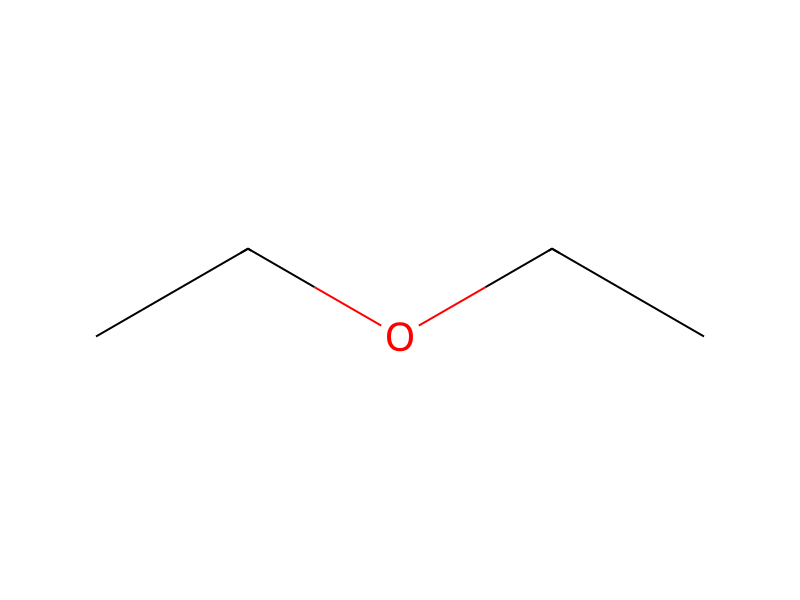
[F:1][CH:2]([F:17])[O:3][C:4]1[CH:9]=[CH:8][C:7]([CH:10]([CH:14]([CH3:16])[CH3:15])[C:11]([OH:13])=[O:12])=[CH:6][CH:5]=1.[N+](C1C=CC(C(O)C(N(C)C)CO)=CC=1)([O-])=O.COC1C=CC2N=CC=C([C@@H](O)[C@H]3N4C[C@H](C=C)[C@@H](CC4)C3)C=2C=1>CCOCC>[F:1][CH:2]([F:17])[O:3][C:4]1[CH:5]=[CH:6][C:7]([C@H:10]([CH:14]([CH3:15])[CH3:16])[C:11]([OH:13])=[O:12])=[CH:8][CH:9]=1Participants


Conditions
- Temperature
- 0 °C
Procedure
1 part of 2-(4-difluoromethoxyphenyl)-3-methylbutyric acid is dissolved in 1-5 parts (by weight) of solvent comprising an organic solvent such as an aliphatic alcohol, an aromatic hydrocarbon, a keton, a halogenated hydrocarbon, an ether, an ester, or an aliphatic hydrocarbon, etc. After the dissolution is completed, 1-3 moles of resolving agent, an optically active organic base such as 1-(4-nitrophenyl)-2-dimethylamino-1,3-propanediol, quinine, substituted α-aminoethylbenzene and the like, is added. The mixture thus obtained is stirred at -50° C. to 200° C., preferably at 0° C. to reflux temperature of the solvent, for 0.1-100 hours, preferably for 1-10 hours. After the reaction is completed, the reaction mixture is allowed to cool, the solids are then collected by filtration and the filtrate discarded. The solids were added to an aqueous solution of 0.1%-36%, preferably 5%-20%, hydrochloric acid, and heated with stirring at 0° C.-100° C., preferably at 20° C.-50° C., for 0.2-1 hour. Thereafter, the reaction mixture was allowed to cool to room temperature, extracted with organic solvents such as aromatic hydrocarbons, halogenated hydrocarbons, aliphatic hydrocarbons, ethers, ketones, esters and the like, and then remove the solvent in the extract by distillation to give (S)-2-(4-difluoromethoxyphenyl)-3-methylbutyric acid.
Workup
- customThe mixture thus obtained
- temperatureto reflux temperature of the solvent
- waitpreferably for 1-10 hours
- temperatureto cool
- filtrationthe solids are then collected by filtration
- additionThe solids were added to an aqueous solution of 0.1%-36%, preferably 5%-20%, hydrochloric acid
- temperatureheated
- stirringwith stirring at 0° C.-100° C., preferably at 20° C.-50° C., for 0.2-1 hour
- temperatureto cool to room temperature
- extractionextracted with organic solvents such as aromatic hydrocarbons, halogenated hydrocarbons, aliphatic hydrocarbons, ethers, ketones, esters
- customthe like, and then remove the solvent in the
- extractionextract by distillation
Sources & evidence
- ORD record
- ord-be24fcada0634676a2e4d6eac98f92ee
- Source dataset
- uspto-grants-1999_03
- Patent number
- US05886207
Reaction notes
Loading…