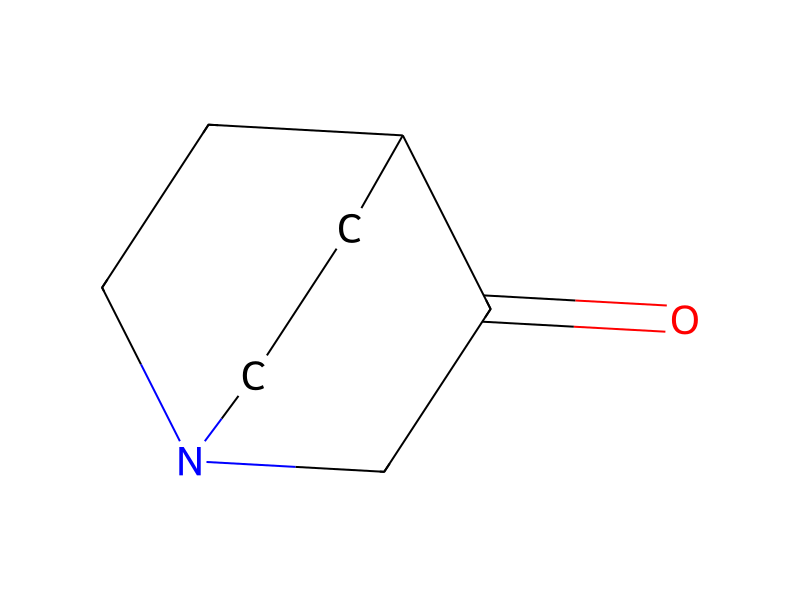
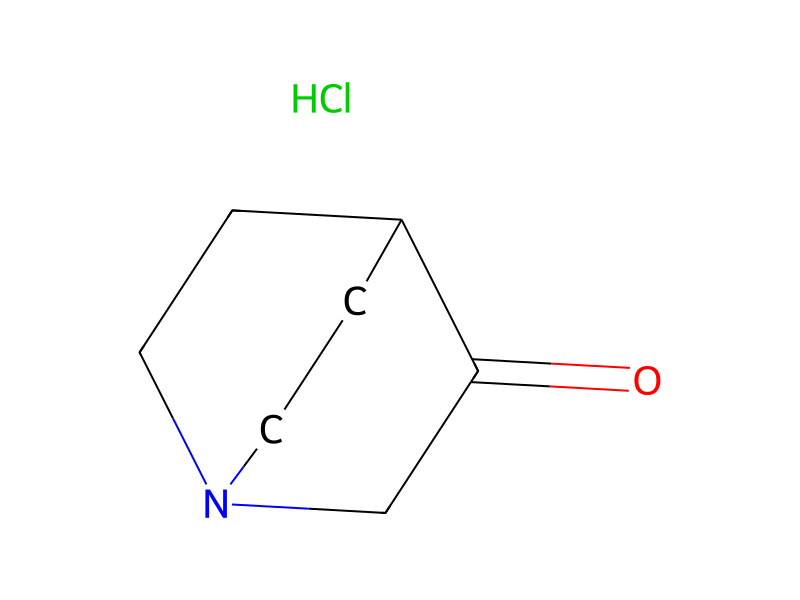
3-Quinuclidinone → (+-)-3-Quinuclidinol
Reaction equation

[N:1]12[CH2:8][CH2:7][CH:4]([CH2:5][CH2:6]1)[C:3](=[O:9])[CH2:2]2.Cl.N12CCC(CC1)C(=O)C2.[H][H]>[OH-].[Zr+4].[OH-].[OH-].[OH-]>[OH:9][CH:3]1[CH:4]2[CH2:7][CH2:8][N:1]([CH2:6][CH2:5]2)[CH2:2]1Participants
5



Procedure
It has also been found that quinuclidin-3-one or a corresponding salt, such as, quinuclidin-3-one hydrochloride, can be reduced by means of a secondary alcohol as the hydrogen donor in the presence of amorphous, partially dehydrated zirconium hydroxide (ZrO2.xH2O) in the manner of a Meerwein-Ponndorf-Verley reduction to give a good yield of 3-hydroxyquinuclidine or the corresponding salt. If the reduction is carried out using a salt of quinuclidin-3-one, the resulting 3-hydroxyquinuclidine salt can, if desired, be converted into the free 3-hydroxyquinuclidine by addition of a strong base during the work-up of the reaction mixture.
Sources & evidence
- ORD record
- ord-50cb0231d2d74b2b9017d3fbca625edb
- Source dataset
- uspto-grants-2000_06
- Patent number
- US06075145
Reaction notes
Loading…