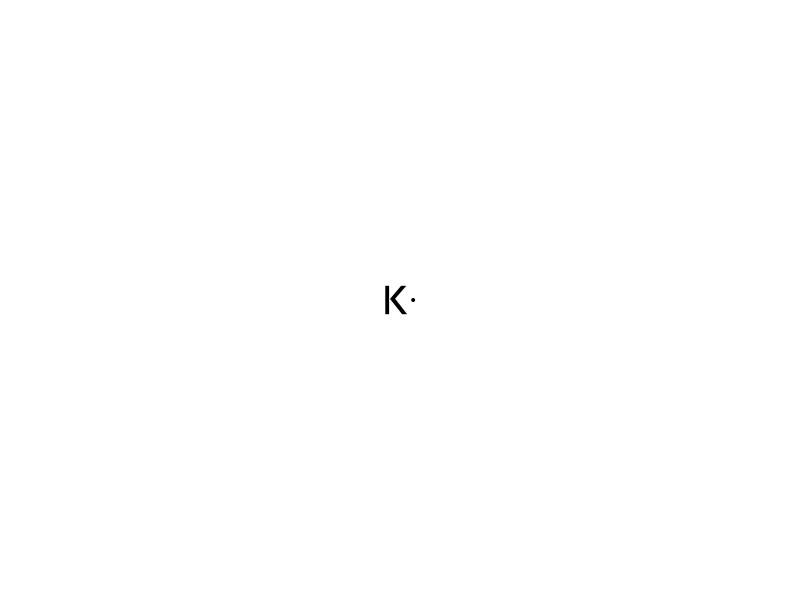
Potassium → Ethyl 8-chloro-1-cyclopropyl-7-fluoro-1,4-dihydro-4-oxo-3-quinolinecarboxylate
Reaction equation

[Cl:1][C:2]1[C:3](F)=[C:4]([CH:18]=[CH:19][C:20]=1[F:21])[C:5]([C:7](=[CH:13][NH:14][CH:15]1[CH2:17][CH2:16]1)[C:8]([O:10][CH2:11][CH3:12])=[O:9])=[O:6].[K]>>[Cl:1][C:2]1[C:20]([F:21])=[CH:19][CH:18]=[C:4]2[C:3]=1[N:14]([CH:15]1[CH2:17][CH2:16]1)[CH:13]=[C:7]([C:8]([O:10][CH2:11][CH3:12])=[O:9])[C:5]2=[O:6]Participants


Procedure
Reaction of 3-chloro-2,4-difluoro-benzoyl chloride with diethyl malonate gives diethyl (3-chloro-2,4-difluoro-benzoyl)-malonate, and partial hydrolysis and decarboxylation lead to ethyl (3-chloro-2,4-difluoro-benzoyl)-acetate, which is reacted with ethyl orthoformate/acetic anhydride to give ethyl 2-(3-chloro-2,4-difluorobenzoyl)-3-ethoxy-acrylate; further reaction with cyclopropylamine leads to ethyl 2-(3-chloro-2,4-difluoro-benzoyl)-3-cyclopropylaminoacrylate, which is cyclized with potassium carbonateldimethylformamide to give ethyl 8-chloro-1-cyclopropyl-7-fluoro-1,4-dihydro-4-oxo-3-quinolinecarboxylate; hydrolysis then finally leads to the corresponding carboxylic acid. The reaction sequence described can be represented by the following equation: ##STR4## The quinolonecarboxylic acid obtained in the 6th stage can be converted by reaction with compounds Z--H of the formulae ##STR5## wherein R1 represents hydrogen, straight-chain or branched C1 -C3 -alkyl or cyclopropyl,
Sources & evidence
- ORD record
- ord-8e3b7b38c3464f0494409fc7a2336007
- Source dataset
- uspto-grants-2000_06
- Patent number
- US06075165
Reaction notes
Loading…