Iodine → Methyl 4-amino-6-chloro-5-fluoro-3-iodopicolinate
Reaction equation

[NH2:1][C:2]1[C:7]([F:8])=[C:6]([Cl:9])[N:5]=[C:4]([C:10]([O:12][CH3:13])=[O:11])[CH:3]=1.[I:14](O)(=O)(=O)=O.II>CO>[NH2:1][C:2]1[C:7]([F:8])=[C:6]([Cl:9])[N:5]=[C:4]([C:10]([O:12][CH3:13])=[O:11])[C:3]=1[I:14]Participants
Reactant 3

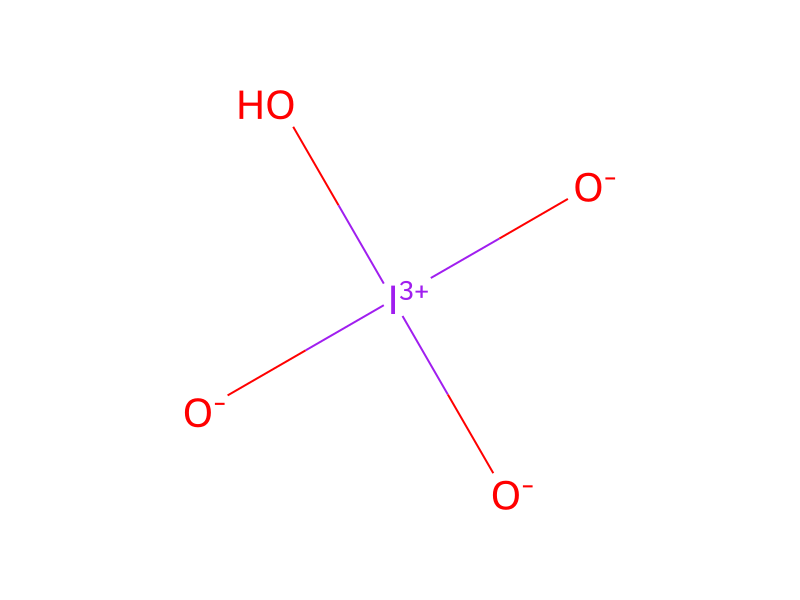

Product 1

Reagents, catalysts & solvents 1

Procedure
Methyl 4-amino-6-chloro-5-fluoropicolinate (2.2 g, 10.8 mmol) was dissolved in methyl alcohol (CH3OH; 20 mL). The solution was treated with periodic acid (880 mg, 3.9 mmol) and iodine (2.2 g, 8.6 mmol) and then heated to reflux for 20 h. The mixture was cooled, and the volatiles were removed under vacuum. The residue was dissolved in EtOAc (50 mL) and then stirred with 10% NaHSO3 solution (20 mL) for 10 min. The organic phase was separated and washed with brine (10 mL), dried (Na2SO4) and evaporated. The residue was purified by silica gel chromatography (5-50% EtOAc-hexane gradient) to give the title compound as a light orange solid (2.5 g, 70%): mp 149-151° C.; ESIMS m/z 330 ([M]+); 1H NMR (400 MHz, CDCl3) δ 5.17 (s, 2H, NH2), 3.97 (s, 3H, OMe); 19F NMR (376 MHz, CDCl3) δ −135.79 (s).
Workup
- temperatureheated
- temperatureto reflux for 20 h
- temperatureThe mixture was cooled
- customthe volatiles were removed under vacuum
- dissolutionThe residue was dissolved in EtOAc (50 mL)
- customThe organic phase was separated
- washwashed with brine (10 mL)
- dry with materialdried (Na2SO4)
- customevaporated
- customThe residue was purified by silica gel chromatography (5-50% EtOAc-hexane gradient)
Sources & evidence
- ORD record
- ord-0987575a97064ef88ee6b7b79f843661
- Source dataset
- uspto-grants-2015_01
- Patent number
- US08927731B2
Reaction notes
Loading…