HCID 178483031, compound → HCID 178508317, compound
Reaction equation

C[N:2](C)[C:3]1[NH:4][CH:5]=[C:6]([C:8]2[C:16]3[C:11](=[CH:12][CH:13]=[CH:14][CH:15]=3)[NH:10][CH:9]=2)[N:7]=1>CO.N>[NH2:2][C:3]1[NH:4][CH:5]=[C:6]([C:8]2[C:16]3[C:11](=[CH:12][CH:13]=[CH:14][CH:15]=3)[NH:10][CH:9]=2)[N:7]=1Participants
Reactant 1

Product 1
Reagents, catalysts & solvents 1

Procedure
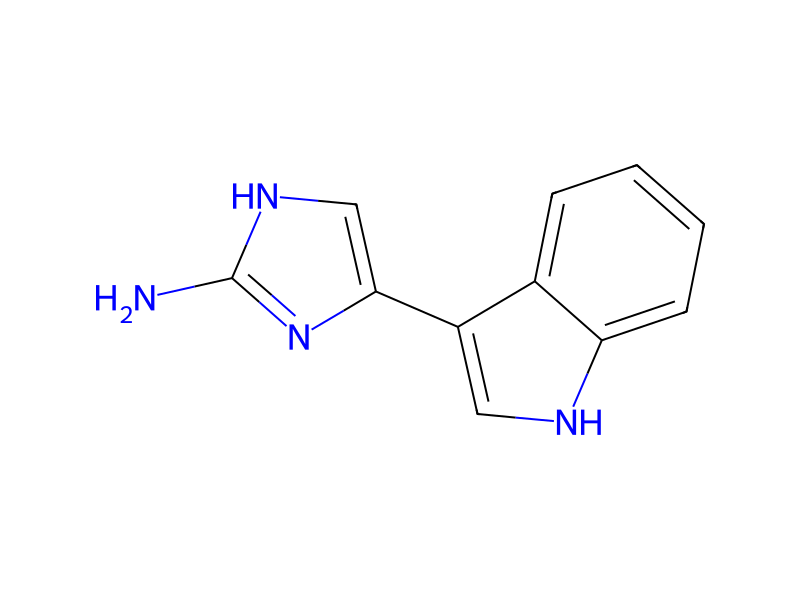
Referring to FIG. 6, similarly, treatment of 2-amino-4-(3-indolyl)imidazole 6 under analogous MeOH—NH3 conditions in air produced fused pentacyclic dimer 9 as a dark-violet to black solid. Upon further standing in MeOH—NH3, dimer 9 underwent aminolysis to afford imine 10. Hydrolysis of the imine functionality of imine 10 gave N,N-didesmethylgrossularine-1 2. Alternatively, N,N-didesmethylgrossularine-1 2 can be obtained directly from the hydrolysis of dimer 9. All spectral data of synthetic N,N-didesmethylgrossularine-1 2 were in excellent agreement with those reported for the natural product.[2] In noting differences between dimethylaminoimidazole 5 and its didesmethyl amino analog 6, the precyclized desmethylamino dimer corresponding to dimer 7 was not obtained in the case of 2-amino-4-(3-indolyl)imidazole 6. This outcome is attributed to the greater solubility of the putative desmethyl intermediate in methanolic ammonia. In the case of 2-dimethylamino-4-(3-indolyl)imidazole 5, N,N-dimethylamino analog 7c corresponding to dimer 9 also was not obtained. The greater propensity towards aminolysis of this putative guanidinium ion intermediate accounts for this result.
Workup
- customgave N,N-didesmethylgrossularine-1 2
- customAlternatively, N,N-didesmethylgrossularine-1 2 can be obtained directly from the hydrolysis of dimer 9
Sources & evidence
- ORD record
- ord-0cef8f500f7b471a8ff9839aa71e858f
- Source dataset
- uspto-grants-2009_11
- Patent number
- US07615638B2
Reaction notes
Loading…