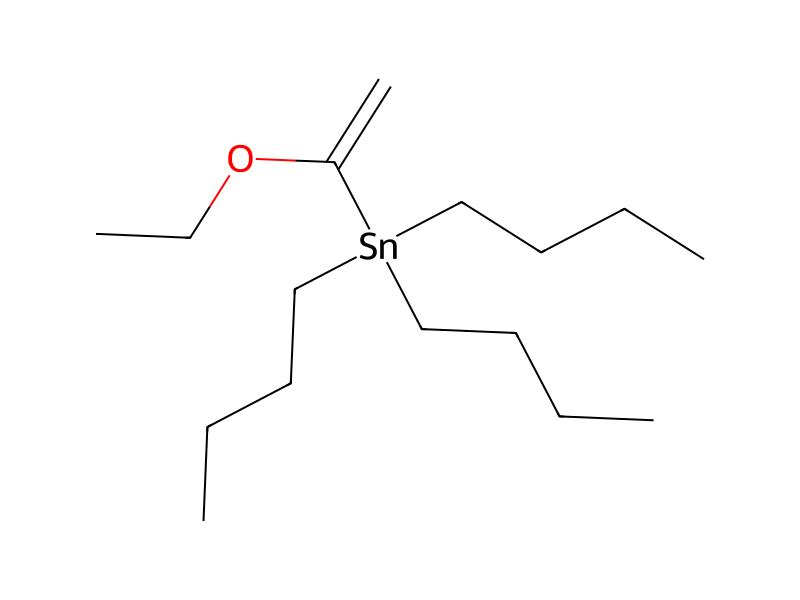
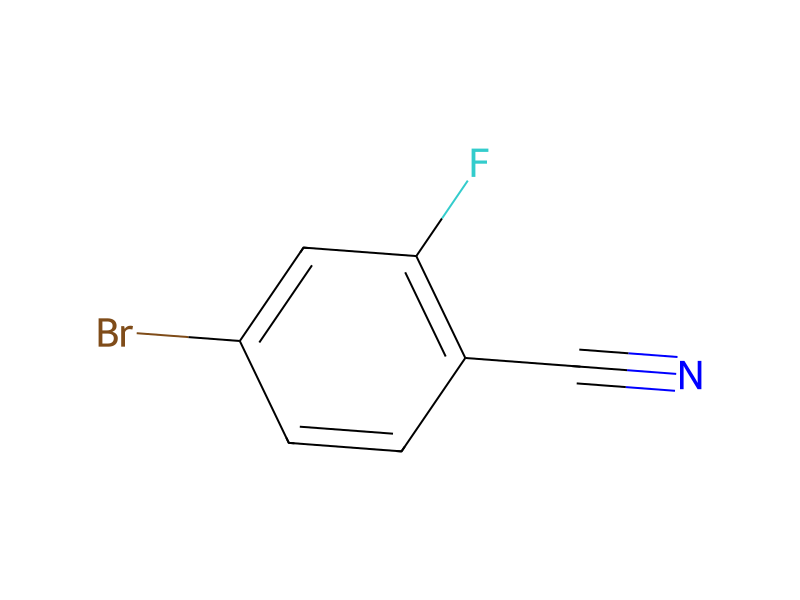
Stannane, tributyl(1-ethoxyethenyl)- → 4-Acetyl-2-fluorobenzonitrile
Reaction equation

Br[C:2]1[CH:9]=[CH:8][C:5]([C:6]#[N:7])=[C:4]([F:10])[CH:3]=1.C([Sn](CCCC)(CCCC)[C:16]([O:18]CC)=[CH2:17])CCC>C1(C)C=CC=CC=1.Cl[Pd](Cl)([P](C1C=CC=CC=1)(C1C=CC=CC=1)C1C=CC=CC=1)[P](C1C=CC=CC=1)(C1C=CC=CC=1)C1C=CC=CC=1>[C:16]([C:2]1[CH:9]=[CH:8][C:5]([C:6]#[N:7])=[C:4]([F:10])[CH:3]=1)(=[O:18])[CH3:17]Participants
5



Procedure
A mixture of 4-bromo-2-fluorobenzonitrile (10.6 g, 52.8 mmol), tributyl(1-ethoxyvinyl)tin (21 g, 58.1 mmol), and trans-dichlorobis(triphenylphosphine)palladium (II) (371 mg, 0.53 mmol) in 190 mL of dry toluene were refluxed for 2 h and then quenched with 5% HCl and stirred for 30 min. Ethyl acetate was added and the layers were separated. The organic layer was dried over anhydrous sodium sulfate, filtered and concentrated under reduced pressure to give 6.5 g of crude product. Purification of the product on silica gel using 5% ethyl acetate:hexane gave 4-acetyl-2-fluorobenzonitrile (1.0 g, 11%), MS (ES) m/z 164 [M+H]+.
Workup
- temperaturewere refluxed for 2 h
- customquenched with 5% HCl
- additionEthyl acetate was added
- customthe layers were separated
- dry with materialThe organic layer was dried over anhydrous sodium sulfate
- filtrationfiltered
- concentrationconcentrated under reduced pressure
- customto give 6.5 g of crude product
- customPurification of the product on silica gel using 5% ethyl acetate
Sources & evidence
- ORD record
- ord-45d16bef3c5945e3bf87a91b22ed8350
- Source dataset
- uspto-grants-2009_11
- Patent number
- US07618990B2
Reaction notes
Loading…