Datp → HCID 86612373, compound
Reaction equation

P(OC[C@H]1[O:19][C@@H:18](N2C=CC(N)=NC2=O)[CH2:17][C@@H:16]1[OH:28])(OP(OP(O)(O)=O)(O)=O)(=O)[OH:2].P([O:41][CH2:42][C@H]1[O:47][C@@H:46](N2C3N=CN=C(N)C=3N=C2)[CH2:45][C@@H]1O)(OP(OP(O)(O)=O)(O)=O)(=O)O.C1N=C(N)C2N=CN([C@@H]3O[C@H](COP(OP(OP(O)(O)=O)(O)=O)(O)=O)[C@@H](C=O)[C@H]3C=O)C=2[N:60]=1>>[CH2:42]([OH:41])[C:17]([NH2:60])([CH2:16][OH:28])[CH2:18][OH:19].[C:46]([O-:47])(=[O:2])[CH3:45]Participants
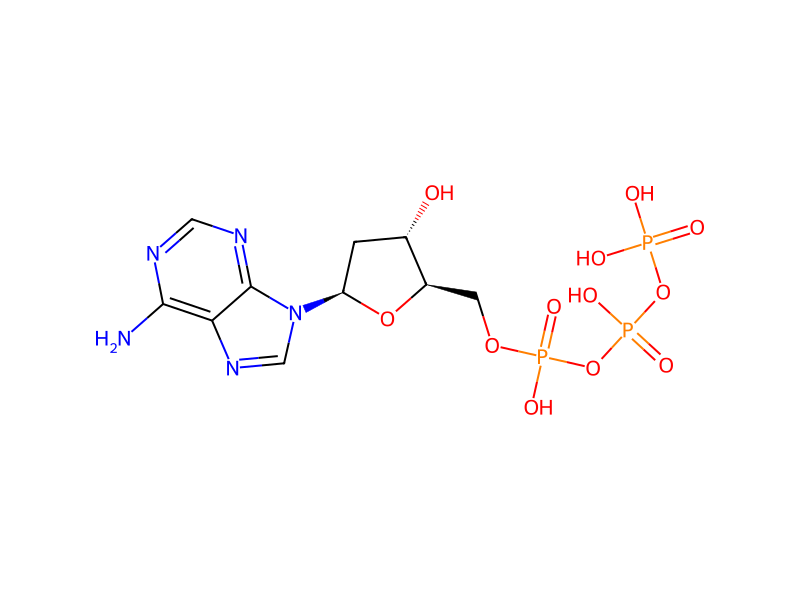


Conditions
- Temperature
- 65 °C
Procedure
A second treatment of the DNA with the Klenow fragment of E. coli DNA polymerase I was conducted as described above except that 0.05 mM deoxycytidine triphosphate was substituted for the 0.05 mM deoxyadenosine triphosphate of the previous reaction. This produced a fragment with the sequence ##STR19## near the beginning of the rennin gene. After phenol extraction, ether extraction, and ethanol precipitation, the DNA was redissolved in water and treated with S1 nuclease (Boehringer/Mannheim, 100 units) for 30 minutes at room temperature i a 50 μl reaction containing Buffer S. This enzyme removed the 5' single-stranded DNA from the fragment leaving the sequence ##STR20## Thus, the beginning of the rennin sequence is at the 5' end of the DNA fragment. A synthetic oligonucleotide containing a ClaI restriction site and ending with the nucleotides ATG (i.e. CATCGATG, Collaborative Research, Inc., 5 μg) was kinased with Y32 -P-ATP using T4 polynucleotide kinase ((P-L Biochemicals, 3 units) for 30 minutes at 37° C. in a 25 μl reaction containing Buffer Y. This kinased linker (about 200 pmoles was ligated to the treated DNA fragment (about 5 pmoles) by incubation with T4DNA Ligase (N.E. Biolabs, 900 units) at 15° C. overnight in Buffer L. The reaction was terminated by heating at 65° C. for 5 minutes. Four microliters of 10x ClaI buffer (1x=10 mM Tris·HCl pH 8, 10 mM MgCl2), and 10 μl of restriction endonuclease ClaI (Boehringer/Mannheim, 27 units) were added. The resulting mixture wax incubated at 37° C. for one hour. Four microliters were removed for analysis on a polyacrylamide gel, followed by the addition of 1 μl of 10x ClaI buffer, 10 μl of ClaI enzyme, and 3 μl water. This mixture was incubated for an additional hour. The treated DNA containing the desired rennin sequences was purified by separation in a 2% agarose gel containing 40 mM Tris·acetate buffer pH 8.3. The DNA was visualized by long wave ultraviolet irradiation and removed from the gel by the freeze-thaw method described above. This fragment was then ready for insertion into the appropriate vector.
Workup
- customThis produced a fragment with the sequence ##STR19## near the beginning of the rennin gene
- extractionAfter phenol extraction, ether extraction, and ethanol precipitation
- dissolutionthe DNA was redissolved in water
- additiontreated with S1 nuclease (Boehringer/Mannheim, 100 units) for 30 minutes at room temperature i a 50 μl reaction
- additioncontaining Buffer S
- customThis enzyme removed the 5' single-stranded DNA from the fragment
- customleaving the sequence ##STR20## Thus, the beginning of the rennin sequence
- customfor 30 minutes
- customat 37° C.
- customin a 25 μl reaction
- additioncontaining Buffer Y
- customThe reaction was terminated
- additionFour microliters of 10x ClaI buffer (1x=10 mM Tris·HCl pH 8, 10 mM MgCl2), and 10 μl of restriction endonuclease ClaI (Boehringer/Mannheim, 27 units) were added
- customFour microliters were removed for analysis on a polyacrylamide gel
- additionfollowed by the addition of 1 μl of 10x ClaI buffer
- waitThis mixture was incubated for an additional hour
- customThe treated DNA containing the desired rennin sequences was purified by separation in a 2% agarose gel
- additioncontaining 40 mM Tris·acetate buffer pH 8.3
- customThe DNA was visualized by long wave ultraviolet irradiation
- customremoved from the gel by the freeze-thaw method
Sources & evidence
- ORD record
- ord-ebada0ee8ba04e08915e658042b4c3db
- Source dataset
- uspto-grants-1996_03
- Patent number
- US05496711
Reaction notes
Loading…