Pyridine → HCID 59168391, compound
Reaction equation

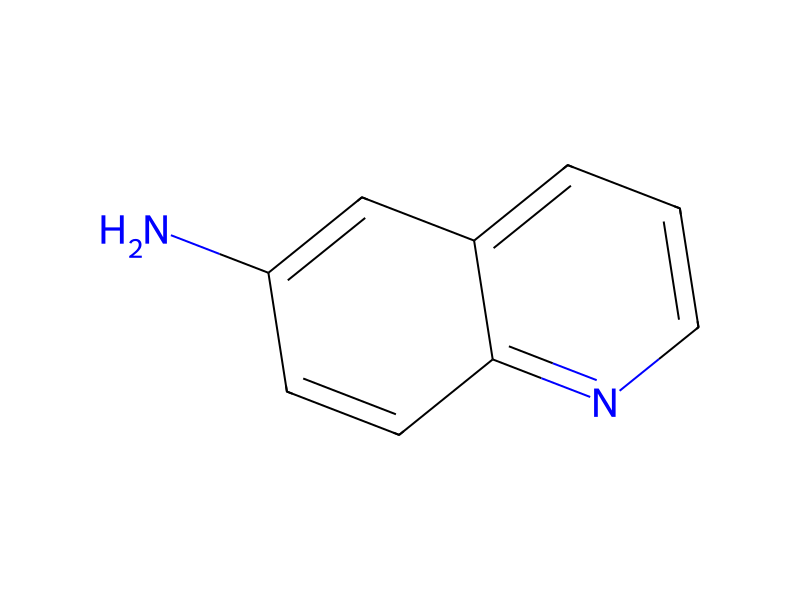
[NH2:1][C:2]1[CH:3]=[C:4]2[C:9](=[CH:10][CH:11]=1)[N:8]=[CH:7][CH:6]=[CH:5]2.[C:12]([CH2:16][C:17](Cl)=[O:18])([CH3:15])([CH3:14])[CH3:13].N1C=CC=CC=1>ClCCl>[CH3:13][C:12]([CH3:15])([CH3:14])[CH2:16][C:17]([NH:1][C:2]1[CH:3]=[C:4]2[C:9](=[CH:10][CH:11]=1)[N:8]=[CH:7][CH:6]=[CH:5]2)=[O:18]Participants
Reactant 3


Product 1

Reagents, catalysts & solvents 1

Procedure
Following the procedure of Example 1, Step 3, 6-nitroquinoline (2.5 g) and 5% palladium on carbon (0.10 g) in ethanol (40 mL) was hydrogenated to give 6-aminoquinoline (2.2 g). A mixture of 6-aminoquinoline (2.2 g, 15 mmol), t-butylacetyl chloride (2.2 mL, 16 mmol), and pyridine (2.5 mL, 31 mmol) in dichloromethane (40 mL) was then stirred at ambient temperature for 4 h and then extracted with 1 N HCl. The acidic layer was separated and treated with 50% NaOH until basic. The basic phase was extracted with dichloromethane. The combined extracts were dried (MgSO4) and concentrated. The crude material was triturated with hexane and the solid was collected by filtration to provide 3,3-dimethyl-N-quinolin-6-ylbutanamide (3.0 g). MS (ES) m/z 241.1.
Workup
- extractionextracted with 1 N HCl
- customThe acidic layer was separated
- additiontreated with 50% NaOH until basic
- extractionThe basic phase was extracted with dichloromethane
- dry with materialThe combined extracts were dried (MgSO4)
- concentrationconcentrated
- customThe crude material was triturated with hexane
- filtrationthe solid was collected by filtration
Sources & evidence
- ORD record
- ord-62337381918341f09ef95b873faf6282
- Source dataset
- uspto-grants-2010_02
- Patent number
- US07662831B2
Reaction notes
Loading…