Potassium Phosphate, Tribasic → HCID 22317976, compound
Reaction equation

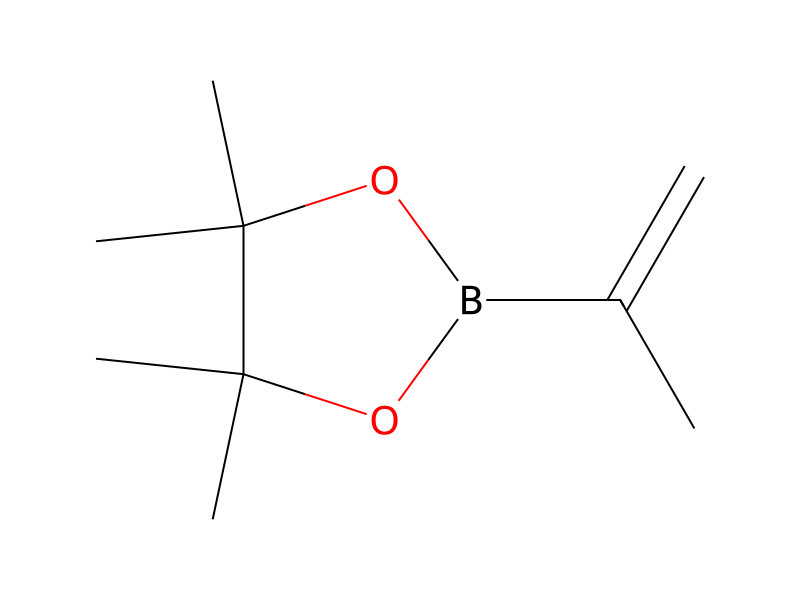
I[C:2]1[CH:7]=[CH:6][C:5]([Br:8])=[CH:4][N:3]=1.[C:9](B1OC(C)(C)C(C)(C)O1)([CH3:11])=[CH2:10].P([O-])([O-])([O-])=O.[K+].[K+].[K+]>COCCOC.O.C1C=CC(P(C2C=CC=CC=2)[C-]2C=CC=C2)=CC=1.C1C=CC(P(C2C=CC=CC=2)[C-]2C=CC=C2)=CC=1.Cl[Pd]Cl.[Fe+2]>[Br:8][C:5]1[CH:6]=[CH:7][C:2]([C:9]([CH3:11])=[CH2:10])=[N:3][CH:4]=1Participants
Reactant 3


Product 1

Reagents, catalysts & solvents 3



Conditions
- Temperature
- 80 °C
Procedure
5-Bromo-2-isopropenyl-pyridine was prepared according to the scheme shown in FIG. 9. In the sealed round bottom flask, 2-Iodo-5-bromopyridine (4.34 g, 15.3 mmol), isopropenylboronic acid pinacol ester (2.57 g, 15.3 mmol), PdCl2(dppf) (1.87 g, 2.3 mmol) and potassium phosphate (8.2 g, 38 mmol) were dissolved in 25 mL DME and 8 mL water. The resulting solution was stirred at 80° C. for 3 hours and was then cooled down to room temperature. After separation, the aqueous phase was extracted with EtOAc. The combined organic layers were washed with brine and dried over Na2SO4. After removing the solvent, fairly pure product (about 3.0 g) was obtained as yellow solid, which was directly used for next step without further purification. ESI MS m/z 198, 200 (M+H).
Workup
- temperaturewas then cooled down to room temperature
- customAfter separation
- extractionthe aqueous phase was extracted with EtOAc
- washThe combined organic layers were washed with brine
- dry with materialdried over Na2SO4
- customAfter removing the solvent
Sources & evidence
- ORD record
- ord-d235dfdfce544adf8ff6620ebe5ec44e
- Source dataset
- uspto-grants-2010_02
- Patent number
- US07666864B2
Reaction notes
Loading…