Thionyl Chloride → HCID 16639920, compound
Reaction equation

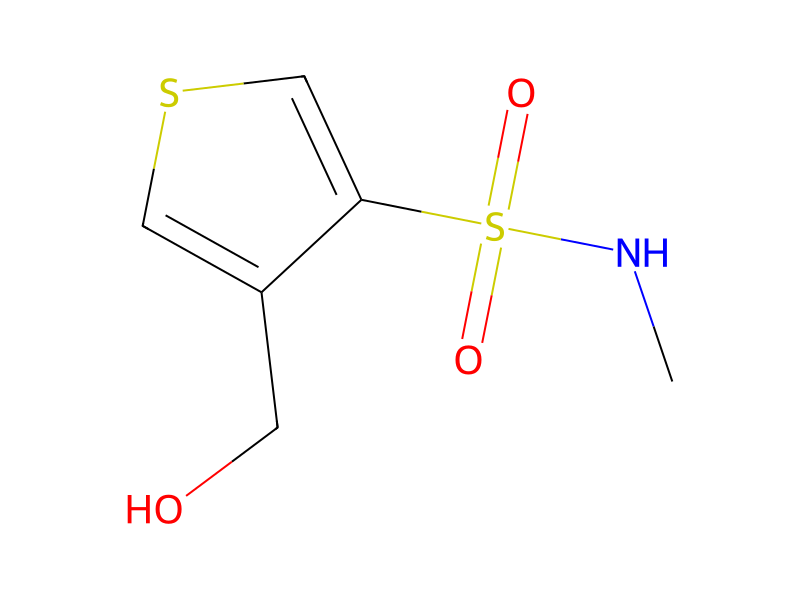
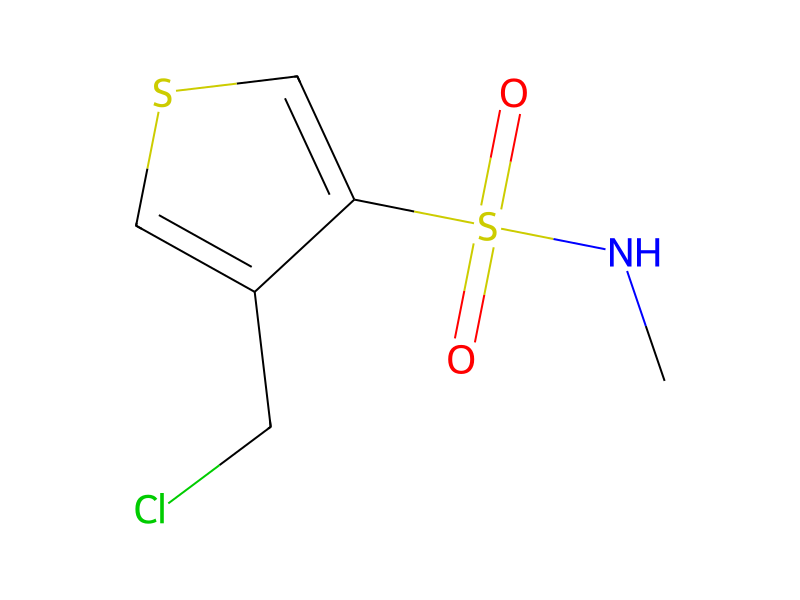
O[CH2:2][C:3]1[C:7]([S:8]([NH:11][CH3:12])(=[O:10])=[O:9])=[CH:6][S:5][CH:4]=1.S(Cl)([Cl:15])=O>>[Cl:15][CH2:2][C:3]1[C:7]([S:8]([NH:11][CH3:12])(=[O:10])=[O:9])=[CH:6][S:5][CH:4]=1Participants

Procedure
23.8 g (0.115 mol) of 3-hydroxymethyl-N-methyl-4-thiophenesulfonamide are treated within 10 minutes with 120 ml of thionyl chloride and the mixture is boiled under reflux for 20 minutes. Thereafter, the mixture is evaporated to dryness in a water-jet vacuum. The residue is taken up in 500 ml of methylene chloride and stirred with saturated sodium bicarbonate solution until the aqueous phase has an alkaline reaction. The phases are separated and the aqueous phase is extracted with two 100 ml portions of methylene chloride. The combined organic phases are dried over sodium sulfate and evaporated. The residual oil crystallizes out upon cooling. There is obtained 3-chloromethyl-N-methyl-4-thiophenesulfonamide of melting point 75°-76° C.
Workup
- temperatureunder reflux for 20 minutes
- customThereafter, the mixture is evaporated to dryness in a water-jet vacuum
- customan alkaline reaction
- customThe phases are separated
- extractionthe aqueous phase is extracted with two 100 ml portions of methylene chloride
- dry with materialThe combined organic phases are dried over sodium sulfate
- customevaporated
- customThe residual oil crystallizes out
- temperatureupon cooling
Sources & evidence
- ORD record
- ord-fba2101e036e414692bb7fca22889db3
- Source dataset
- uspto-grants-1980_02
- Patent number
- US04187303
Reaction notes
Loading…