Boron trifluoride etherate → (E)-1-(2,6,6-trimethylcyclohex-2-en-1-yl)but-2-en-1-one
Reaction equation

[CH3:1][C:2]([CH2:9][CH2:10][CH:11]=[C:12]([CH3:14])[CH3:13])=[CH:3][C:4](=[O:8])[CH:5]=[CH:6][CH3:7].CC(C(C)CC=C(C)C)=CC=O.B(F)(F)F.CCOCC>C1C=CC=CC=1>[CH3:1][C:2]1[CH:3]([C:4](=[O:8])/[CH:5]=[CH:6]/[CH3:7])[C:12]([CH3:13])([CH3:14])[CH2:11][CH2:10][CH:9]=1Participants
5
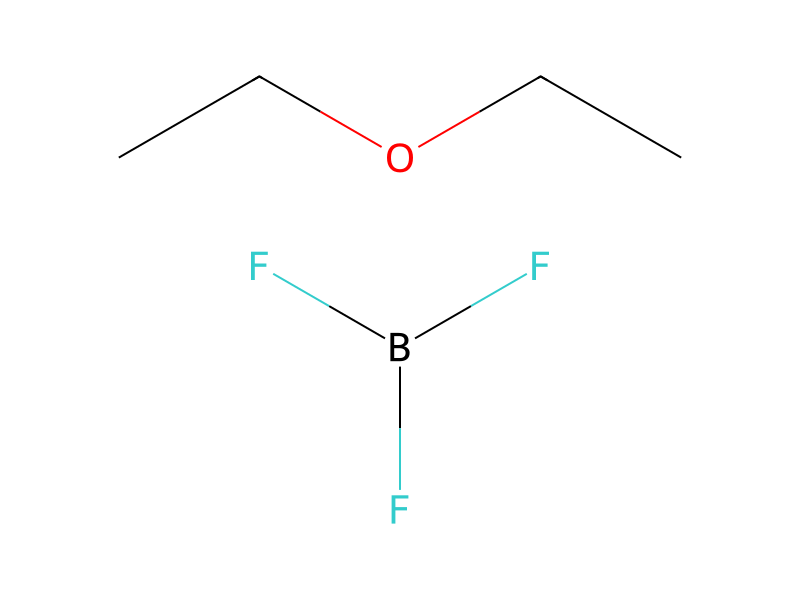


Procedure
A mixture of 10 g. of 6,10-dimethyl-4-oxo-2,5,9-undecatriene prepared according to the method of paragraph (c) herebelow, 100 ml. of benzene and 1 g. of boron trifluoride etherate was heated to the reflux until the vapour phase chromatographic analysis of a sample showed that practically all the starting material had disappeared. The solution was cooled and stirred with ice-water. The organic layer was removed and treated as usual. Distillation of the residue of evaporation gave a 50% yield of trans-2,6,6-trimethyl-1-crotonoyl-2-cyclohexene of about 60% purity as shown by the vapour phase chromatographic analysis.
Workup
- additionA mixture of 10 g
- temperaturereflux until the vapour phase chromatographic analysis of a sample
- temperatureThe solution was cooled
- customThe organic layer was removed
- additiontreated as usual
- distillationDistillation of the residue of evaporation
Sources & evidence
- ORD record
- ord-686421e94e544d1aa2ca64c73f777b9a
- Source dataset
- uspto-grants-1980_02
- Patent number
- US04187863
Reaction notes
Loading…