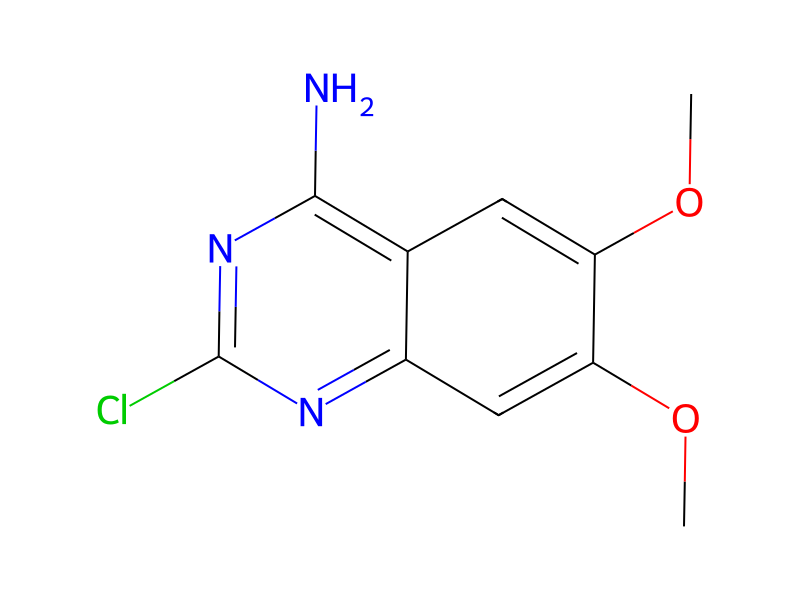
2-Chloro-6,7-dimethoxy-4-quinazolinamine → HCID 13723660, compound
Reaction equation

[NH2:1][C:2]1[C:11]2[C:6](=[CH:7][C:8]([O:14][CH3:15])=[C:9]([O:12][CH3:13])[CH:10]=2)[N:5]=[C:4]([Cl:16])[N:3]=1.[O:17]1[C:22]2[CH:23]=[CH:24][CH:25]=[CH:26][C:21]=2[O:20][CH2:19][CH:18]1[C:27]([N:29]1[CH2:35][CH2:34][CH2:33][NH:32][CH2:31][CH2:30]1)=[O:28]>C(O)CCC>[ClH:16].[NH2:1][C:2]1[C:11]2[C:6](=[CH:7][C:8]([O:14][CH3:15])=[C:9]([O:12][CH3:13])[CH:10]=2)[N:5]=[C:4]([N:32]2[CH2:33][CH2:34][CH2:35][N:29]([C:27]([CH:18]3[O:17][C:22]4[CH:23]=[CH:24][CH:25]=[CH:26][C:21]=4[O:20][CH2:19]3)=[O:28])[CH2:30][CH2:31]2)[N:3]=1Participants



Procedure
4-Amino-2-chloro-6,7-dimethoxyquinazoline (1.58 g.) and N-(1,4-benzodioxan-2-carbonyl)homopiperazine (2.0 g.) were heated under reflux in n-butanol (114 ml.) for 60 hours. The mixture was then cooled, butanol removed in vacuo and the solid residue triturated with ether, taken up in hot methanol, filtered and cooled. The solid product was collected, then the residual solution was evaporated in vacuo and the residue taken up in hot isopropanol, cooled, filtered, then re-evaporated in vacuo. The residue was combined with the original solid product, treated with cold methanol, and recrystallized from ethanol to give 4-amino-2-[4-(1,4-benzodioxan-2-carbonyl)homopiperazin-1-yl]-6,7-dimethoxyquinazoline hydrochloride (0.57 g.), m.p. 250°-251° C.
Workup
- temperatureThe mixture was then cooled
- custombutanol removed in vacuo
- customthe solid residue triturated with ether
- filtrationfiltered
- temperaturecooled
- customThe solid product was collected
- customthe residual solution was evaporated in vacuo
- temperaturecooled
- filtrationfiltered
- customre-evaporated in vacuo
- additiontreated with cold methanol
- customrecrystallized from ethanol
Sources & evidence
- ORD record
- ord-7e753f9957b1465d8a0e64281c8e7269
- Source dataset
- uspto-grants-1980_02
- Patent number
- US04188390
Reaction notes
Loading…