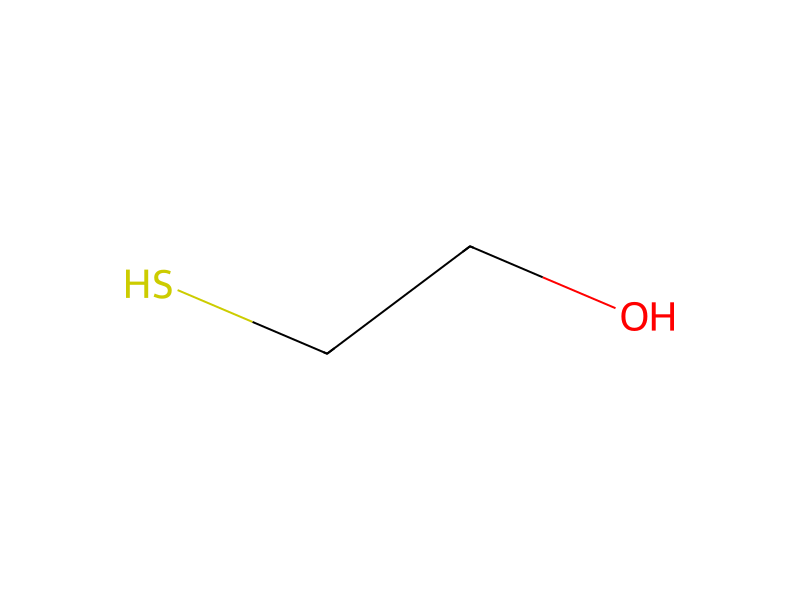
2-Mercaptoethanol → Vinyl chloride-vinyl acetate
Reaction equation

[CH:1]([Cl:3])=[CH2:2].[C:4]([O:7][CH:8]=[CH2:9])(=[O:6])[CH3:5].SCCO>O>[CH3:5][C:4]([O:7][CH:8]=[CH2:9])=[O:6].[CH2:2]=[CH:1][Cl:3]Participants
Reactant 3


Product 1

Reagents, catalysts & solvents 1

Procedure
30 kg of deionized water, 20 g of partially saponified polyvinyl alcohol, a monomer mixture composed of 12.7 kg of vinyl chloride monomer and 2.3 kg of vinyl chloride monomer and 2,3 kg of vinyl acetate monomer and 7.5 g of α,α'-azobis-2,4-dimethylvaleronitrile were introduced into the same reactor used in Example 4. The polymerization reaction was begun and when the monomer conversion reached 12%, 15.0 g of 2-mercaptoethanol were added to the polymerization mixture and the polymerization reaction was continued. After an overall polymerization time of 11 hours and 20 minutes, the polymerization reaction was stopped and, after removal of the unreacted monomers, the resultant copolymer in the aqueous slurry was dehydrated and dried to give a finished product of vinyl chloride-vinyl acetate copolymer. The properties of thus prepared copolymer product were examined to give the results as set forth in Experiment No. 38 in Table VII.
Workup
- additionwere introduced into the same reactor
- customThe polymerization reaction
- additionwere added to the polymerization mixture
- customthe polymerization reaction
- customAfter an overall polymerization time of 11 hours and 20 minutes, the polymerization reaction
- customafter removal of the unreacted monomers
- customdried
Sources & evidence
- ORD record
- ord-2d600c4ccb884fdaa0e1b85ab5568fa8
- Source dataset
- uspto-grants-1980_02
- Patent number
- US04189552
Reaction notes
Loading…