Cyclohexanone → 1,1-Dimethoxycyclohexane
Reaction equation

[CH3:1][O:2][C:3]1([O:9][CH3:10])[CH2:8][CH2:7][CH2:6][CH2:5][CH2:4]1.C1(=O)CCCCC1.C1(=O)CCCCC1>CO>[CH3:1][O:2][C:3]1([O:9][CH3:10])[CH2:8][CH2:7][CH2:6][CH2:5][CH2:4]1Participants
Reactant 2


Product 1

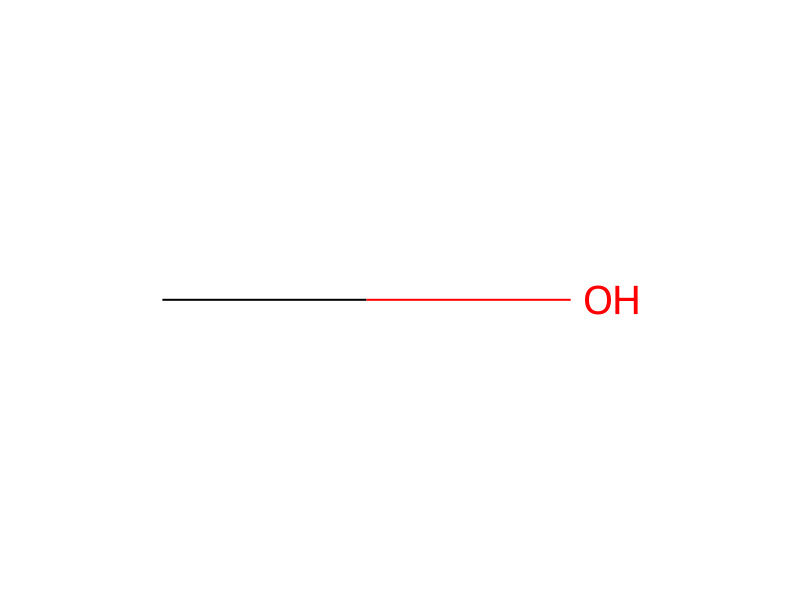
Reagents, catalysts & solvents 1
Procedure
A number of runs were carried out employing a solution of 1,1-dimethoxycyclohexane/cyclohexanone (100 g., 80/20 molar equilibrium mixture @ 10° C.--an equilibrium mixture of 1,1-dimethoxycyclohexane/cyclohexanone as was derived from regeneration of cyclohexanone and methanol to yield the dehydration agent 1,1-dimethoxycyclohexane as hereinafter described) charged into a stirred magnedrive 500 ml Hastelloy (nickel-molybdenum) autoclave along with sodium tetrachloropalladate (1.30 g., 4.1 mmoles) and copper (II) chloride (1.40 g., 10.4 mmole). 1.3-butadiene (100 ml) was charged into the autoclave as a liquid under pressure. The oxidative carbonylation reaction was carried out at 110° C. and 1800 psig total system pressure under continuous gas and liquid flow conditions. A carbon monoxide/air flow rate of 3 liters/minute was maintained for a four hour reaction period with a carbon monoxide to air ratio of 3:1. The entering gas stream contained 6-volume percent oxygen and the exiting gas stream contained 3.5 volume percent oxygen. 1,3-butadiene was fed into the reactor via a high pressure liquid feed pump at a rate of 100 ml/hour and the 1,1-dimethoxycyclohexane/cyclohexanone liquid feed was fed into the reactor at 100 ml/hr. The catalyst solution containing sodium tetrachloropalladate (0.41 moles/liter) and copper (II) chloride (1.04 moles/liter) in methanol was injected into the autoclave with a high pressure pump at a rate of 10 ml/hour along with the 80/20 molar equilibrium liquid feed mixture. As the oxidative carbonylation reaction is taking place the resulting reaction product mixture exited the reaction zone, it was stepped down to atmospheric pressure and was passed through a water-cooled condenser which was operating under a temperature gradient to control aerosol-formation from the autoclave. The product then passed into a gas-liquid separator where the unreacted butadiene, carbon monoxide, and air were recovered from the top of the separator for recycle (to the oxidative carbonylation reactor). The liquid product, dimethyl hex-3 -endioate and some by products were then routed to a distillation train for separation and recovery for hydrogenation to dimethyl adipate.
Sources & evidence
- ORD record
- ord-41e3cce4a381481c93dc5a762e258711
- Source dataset
- uspto-grants-1980_02
- Patent number
- US04189599
Reaction notes
Loading…