Water → 3,3-Dimethyloctahydroquinoxalin-2(1H)-one
Reaction equation

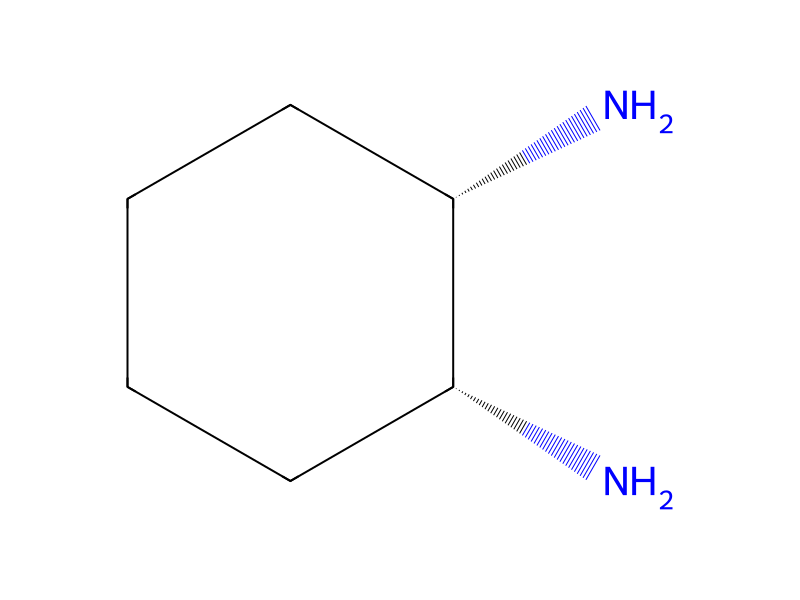
[CH3:1][C:2]([CH3:6])(O)[C:3]#[N:4].[NH2:7][C@@H:8]1[CH2:13][CH2:12][CH2:11][CH2:10][C@@H:9]1N.[OH2:15]>>[CH3:1][C:2]1([CH3:6])[NH:7][CH:8]2[CH:13]([CH2:12][CH2:11][CH2:10][CH2:9]2)[NH:4][C:3]1=[O:15]Participants



Procedure
3,3-dimethyl-decahydroquinoxalin-2-one is prepared as described by Bindler (U.S. Pat. No. 2,920,077) as follows: 17 parts of acetone cyanohydrin are added dropwise at room temperature to a solution of 22.8 parts of cis-1,2-diamino cyclohexane in 100 parts of water. The solution becomes cloudy and an oil is split off. After stirring for half an hour at room temperature, the dispersion is heated to 90°-95° and stirred for another 8 hours at room temperature while ammonia is evolved. The reaction solution is then evaporated to dryness under vacuum and a yellow residue is recrystallized from acetone. The compound melts at 165°-6° C. and is identified as 3,3-dimethyl-decahydroquinoxalin-2-one. 0.5 phr (parts per hundred parts resin) is blended into Hercules Profex 6501 polypropylene and extruded into film. The film is weathered in a Xenon Weather-O-Meter until initiation of decomposition which occurs at about 2000 hours (See Table I).
Workup
- customan oil is split off
- temperaturethe dispersion is heated to 90°-95°
- stirringstirred for another 8 hours at room temperature while ammonia
- customThe reaction solution is then evaporated to dryness under vacuum
- customa yellow residue is recrystallized from acetone
Sources & evidence
- ORD record
- ord-413a70b1cb16414f8260b954e1c25d65
- Source dataset
- uspto-grants-1980_02
- Patent number
- US04190571
Reaction notes
Loading…