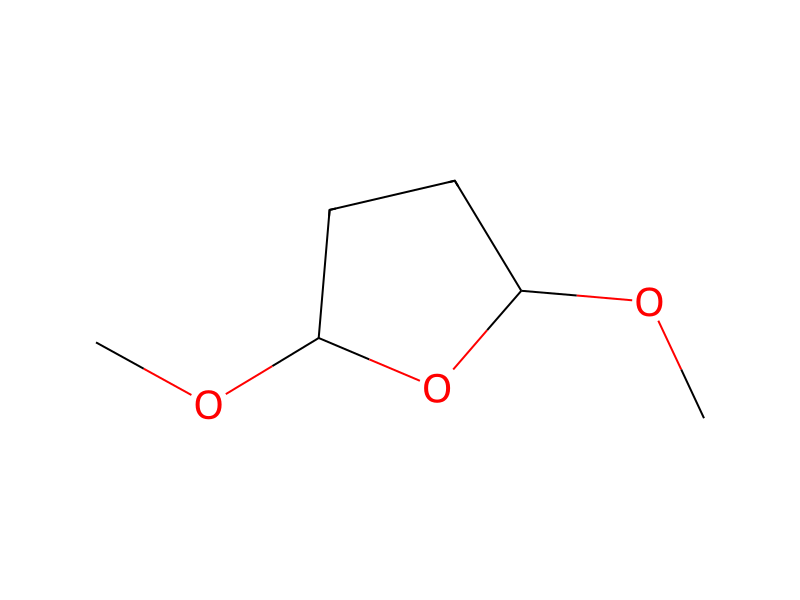
2,5-Dimethoxytetrahydrofuran → 4-Methyl-3-nitro-2-(1H-pyrrol-1-yl)pyridine
Reaction equation

[CH3:1][C:2]1[CH:7]=[CH:6][N:5]=[C:4]([NH2:8])[C:3]=1[N+:9]([O-:11])=[O:10].CO[CH:14]1[CH2:18][CH2:17][CH:16](OC)O1>CC(O)=O>[CH3:1][C:2]1[CH:7]=[CH:6][N:5]=[C:4]([N:8]2[CH:14]=[CH:18][CH:17]=[CH:16]2)[C:3]=1[N+:9]([O-:11])=[O:10]Participants
4
Reactant 2

Product 1

Reagents, catalysts & solvents 1

Procedure
11.82 g (0.0581 mol; yield: 90.4%) of a yellow powder, which turns red in air, are obtained by carrying out the reaction in the same way as in Stage B of Example 92 but starting from 9.85 g (0.0643 mol) of 4-methyl-3nitro-2-aminopyridine and using 10.2 g (0.0772 mol; 1.2 eq) of 2,5-dimethoxytetrahydrofuran and 200 cm3 of glacial CH3CO2H, and bringing the solution to reflux for 3 h.
Workup
- customare obtained
- customthe reaction in the same way as in Stage B of Example 92
- temperatureto reflux for 3 h.
Sources & evidence
- ORD record
- ord-a2d95ff4d4b44dbb9bff8ace7f3baa3c
- Source dataset
- uspto-grants-1997_02
- Patent number
- US05599812
Reaction notes
Loading…