Ethylbenzene → Cumene
Reaction equation

[CH2:1]([C:3]1[CH:8]=[CH:7][CH:6]=[CH:5][C:4]=1[CH2:9][CH3:10])C.[CH2:11]([C:13]1[CH:18]=[CH:17][CH:16]=[CH:15][CH:14]=1)[CH3:12]>C1C=CC=CC=1>[C:4]1([CH:9]([CH3:10])[CH3:11])[CH:3]=[CH:8][CH:7]=[CH:6][CH:5]=1.[CH3:1][CH2:12][CH2:11][C:13]1[CH:18]=[CH:17][CH:16]=[CH:15][CH:14]=1Participants
Reactant 2


Product 2
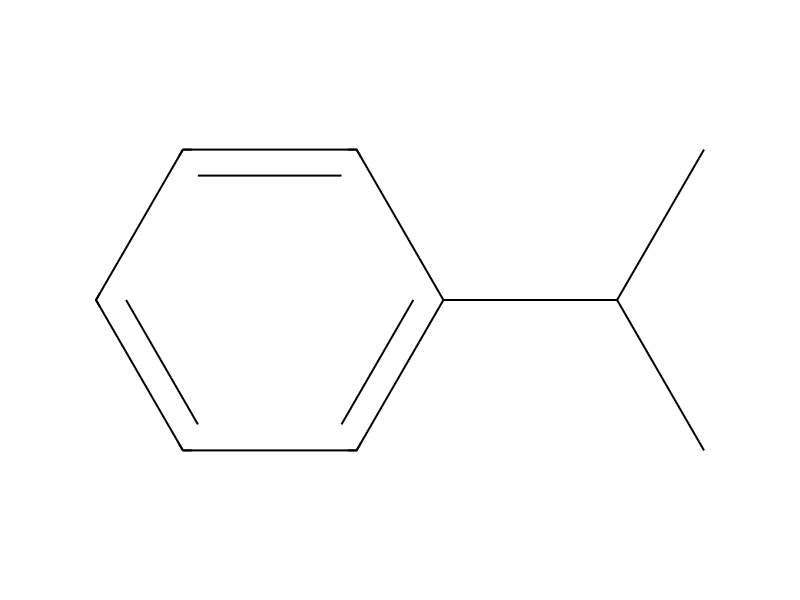

Reagents, catalysts & solvents 1

Procedure
Additional synergies can be realized from integrating the process of this invention with a downstream transalkylation process as illustrated in FIG. 2. Thus, concentrated reactor effluent stream 52 containing crude ethylbenzene, about 20-80 wt. % benzene, and higher-boiling polyalkylated aromatics may be directed to a second benzene recovery column 110 to separate a crude ethylbenzene product stream 70 from a benzene stream 72. The crude ethylbenzene stream 70, including components such as cumene, n-propylbenzene, and other alkylaromatics heavier than ethylbenzene, plus other heavy material, is sent to a third fractionation column 120 in which an ethylbenzene product 74 is distilled overhead. A crude polyethylbenzene stream 76 is recovered from the bottom of column 120 and directed to a fourth fractionation column 130. In column 130, polyethylbenzenes, including diethylbenzene, cumene, n-propylbenzene, and other alkylaromatics heavier than ethylbenzene, are separated from heavy residue material 78, removed as overhead stream 80, and combined with at least a portion of benzene vapor stream 72 coming from column 110 to form a mixed stream 82. Mixed stream 82 is then fed to a secondary transalkylation reactor 140 operating in the vapor phase. In this secondary, transalkylation reactor, in the presence of a suitable catalyst and under proper reactor conditions, the transalkylation of diethylbenzene to ethylbenzene is promoted as well as the dealkylation of higher alkylbenzenes, such as cumene, and n-propylbenzene, to form benzene and light gases. Transalkylation product stream 84 from reactor 140, comprising ethylbenzene, benzene, light gases, and unreacted components, is :fed to a stabilizer/absorber unit 150. Vapor stream 59 coming from the partial condenser associated with column 14 may also be fed to stabilizer 150 to recover the aromatic components. The light gases 86 recovered from the stabilizer may be combusted as fuel. The stabilizer bottoms stream 88 may be returned to benzene recovery column 110, for example, for further recovery of benzene and ethylbenzene as described above.
Workup
- concentrationThus, concentrated reactor effluent stream 52 containing crude ethylbenzene, about 20-80 wt. % benzene
- customto separate a crude ethylbenzene product stream 70 from a benzene stream 72
- distillationis distilled overhead
- customA crude polyethylbenzene stream 76 is recovered from the bottom of column 120
- customare separated from heavy residue material 78
- customremoved as overhead stream 80
- customto form a mixed stream 82
- additionMixed stream 82
- customis then fed to a secondary transalkylation reactor
Sources & evidence
- ORD record
- ord-4aa9f8406503449ba25656d12ec4f72c
- Source dataset
- uspto-grants-1997_02
- Patent number
- US05602290
Reaction notes
Loading…