HuagongsheHuagongshe Chemistry Print Report · For research reference only
HRID 1451069Generated: October 28, 2026
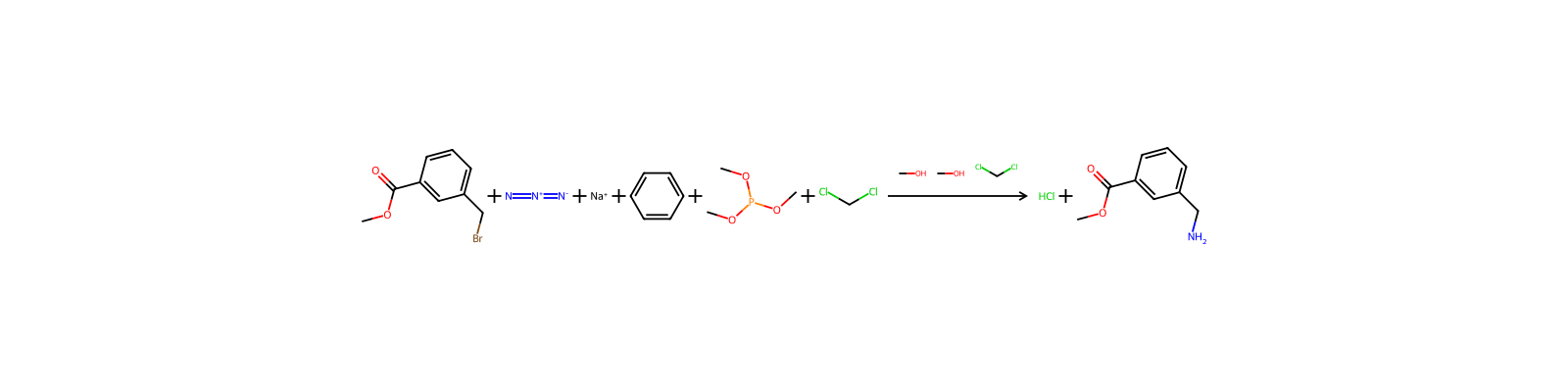
Benzene → Methyl 3-(aminomethyl)benzoate Hydrochloride
https://huagongshe.com/reaction/1451069
Participants
| Role | Name | HCID | Charge |
|---|
| Reactant | Benzene | HCID 241 | — |
| Reactant | Dichloromethane | HCID 6344 | — |
| Reactant | Trimethyl phosphite | HCID 8472 | — |
| Reactant | Sodium Azide | HCID 33557 | — |
| Reactant | Methyl 3-(bromomethyl)benzoate | HCID 517981 | — |
| Solvent | Methanol | HCID 887 | — |
| Solvent | Dichloromethane methanol | HCID 21226129 | — |
| Product | Methyl 3-(aminomethyl)benzoate Hydrochloride | HCID 2794825 | 83% |
Reaction Steps
Methyl-3-bromomethylbenzoate (5.72 g, 0.025 mol, Ryan Chemicals (Maybridge)), sodium azide (3.25 g, 0.05 mol), and tetra n-butylbromide (0.4 g, 0.00125 mol) were added to 100 mL dry benzene in a 250-mL round-bottom flask equipped with a condenser and calcium chloride drying tube in an atmosphere of argon. The mixture was then heated at reflux for 24 h and monitored by TLC (Bakerflex) using dichloromethane, 2% methanol, and 5% methanol/dichloromethane as solvents. The mixture was cooled, the inorganic salts were removed by filtration, and washed with benzene. The filtrate was added to a 250-mL separatory funnel and was then washed three times with water, once with brine, and dried with magnesium sulfate. The drying agent was removed by filtration, and the volume of the clear colorless filtrate was reduced to ~50 mL in a 100-mL round-bottom flask. The solution was saturated with argon and 3.1 g (0.025 mol) trimethylphosphite was added by drop over 10 min. The reaction bubbled during the addition (loss of nitrogen) and was mildly exothermic (once it was necessary to cool on ice with a calcium chloride drying tube in place to keep the temperature below 30° C.). The reaction was followed in the TLC system above and after 18 h, it was necessary to add ~200 mg of additional trimethylphosphite. The reaction was complete after stirring overnight. Anhydrous HCl was then bubbled into the solution with vigorous stirring. After 2 h, a precipitate formed and alter 4 h, the reaction was complete. The white solid was removed by filtration. It was then added to 200 mL ether in a 500-mL Erlenmeyer flask and vigorously stirred for 5 min. After filtration, the solid was dissolved in a minimum amount of boiling methanol and ether was added until the solution was slightly turbid. Cooling, filtering, and drying in vacuo gave 4.2 g (83%) of methyl-3-aminomethylbenzoate hydrochloride, mp 177°-178° C.
Provenance & Evidence
| DOI | 10.6084/m9.figshare.5104873.v1 |
|---|
| Patent number | US05602277 |
|---|
| Source dataset | uspto-grants-1997_02 |
|---|
| ORD ID | ord-aee9be90fa244d9b8515f8f4ddb86d4e |
|---|
| Source note | uspto-grants-1997_02 |
|---|