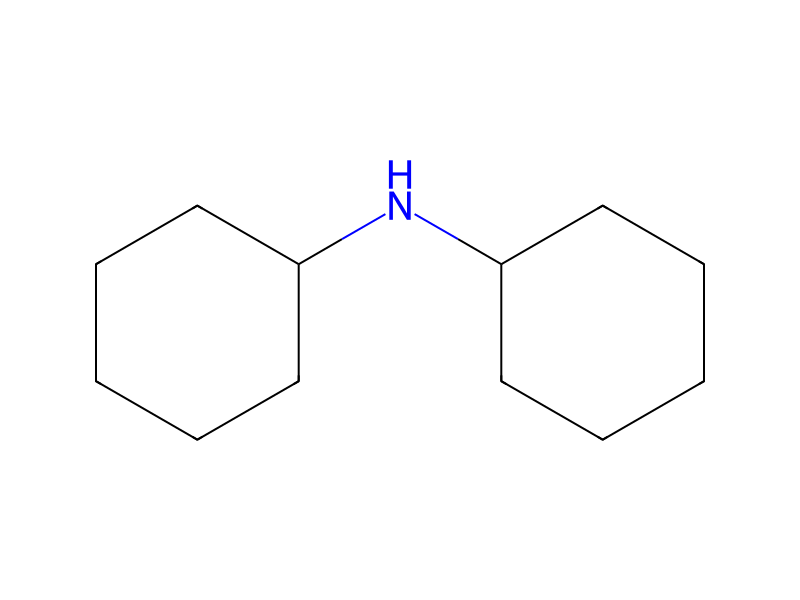
Dicyclohexylamine → (r)-2-Bromoisovaleric acid dicyclohexylamine salt
Reaction equation

[Br:1][C@H:2]([CH:6]([CH3:8])[CH3:7])[C:3]([OH:5])=[O:4].[CH:9]1([NH:15][CH:16]2[CH2:21][CH2:20][CH2:19][CH2:18][CH2:17]2)[CH2:14][CH2:13][CH2:12][CH2:11][CH2:10]1>C1(C)C=CC=CC=1>[CH:16]1([NH:15][CH:9]2[CH2:10][CH2:11][CH2:12][CH2:13][CH2:14]2)[CH2:17][CH2:18][CH2:19][CH2:20][CH2:21]1.[Br:1][C@H:2]([CH:6]([CH3:8])[CH3:7])[C:3]([OH:5])=[O:4]Participants
Reactant 2

Product 1

Reagents, catalysts & solvents 1

Conditions
- Temperature
- 5 °C
Procedure
To 11.81 g of a toluene solution of (R)-2-bromoisovaleric acid obtained in Example 1 (containing 3.00 g of (R)-2-bromoisovaleric acid), 3.19 g of toluene was further added. After continuously adding 3.00 g of dicyclohexylamine under a nitrogen atmosphere at 5° C. for 1 hour to crystallize. They were successively stirred at 5° C. for 2 hours. The obtained crystals were filtered under a reduced pressure and then the crystals were washed with 3 ml of toluene. The obtained crystals were dried under a reduced pressure to obtain 4.84 g of a (R)-2-bromoisovaleric acid dicyclohexylamine salt (optical purity 99.4% ee, crystallization yield 81%, apparent purity 94.5%, impurity content 2-hydroxy isovaleric acid: 0.04%, bromine content: 3.02%).
Workup
- customto crystallize
- filtrationThe obtained crystals were filtered under a reduced pressure
- washthe crystals were washed with 3 ml of toluene
- customThe obtained crystals were dried under a reduced pressure
Sources & evidence
- ORD record
- ord-8ca4b16525834353b901fc96d51e82eb
- Source dataset
- uspto-grants-2009_01
- Patent number
- US07473803B2
Reaction notes
Loading…