HuagongsheHuagongshe Chemistry Print Report · For research reference only
HRID 1455720Generated: October 26, 2026
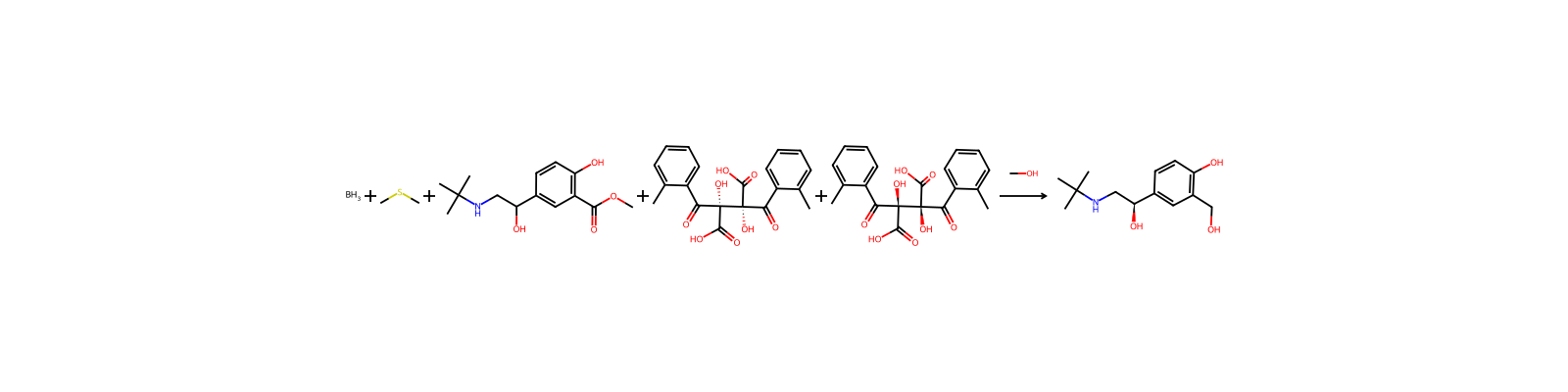
Methyl 5-[2-[(1,1-dimethylethyl)amino]-1-hydroxyethyl]-2-hydroxybenzoate → (-)-Salbutamol
https://huagongshe.com/reaction/1455720
Participants
| Role | Name | HCID | Charge |
|---|
| Reactant | Methyl 5-[2-[(1,1-dimethylethyl)amino]-1-hydroxyethyl]-2-hydroxybenzoate | HCID 11086725 | — |
| Reactant | (Dimethyl sulfide)trihydroboron | HCID 12423031 | — |
| Reactant | Ditoluoyl-l-tartaric acid | HCID 129746773 | — |
| Reactant | (+)-di-toluoyl-D-tartaric acid | HCID 129858806 | — |
| Solvent | Methanol | HCID 887 | — |
| Product | (-)-Salbutamol | HCID 123600 | — |
Reaction Steps
Several patents report synthetic routes using enantiomeric separation, however, the synthetic routes result in low yields of the enantiomerically pure product. Optically pure levalbuterol was synthesized by the borane-methylsulfide reduction of the enantiomerically pure precursor (Formula 2) as described in U.S. Pat. No. 5,399,765. The reaction dissolved a mixture of enantiomers of methyl 5-[2-[(1,1-dimethylethyl)amino]-1-hydroxyethyl]-2-hydroxybenzoate and a chiral acid selected from (−)-di-toluoyl-L-tartaric acid and (+)-di-toluoyl-D-tartaric acid in methanol, upon cooling one stereoisomer crystallized, which was separated, and recrystallized as a diastereomer from methanol, the diastereomer was separated, treated with base, and upon reduction formed optically active levalbuterol.
Provenance & Evidence
| DOI | 10.6084/m9.figshare.5104873.v1 |
|---|
| Patent number | US07482489B2 |
|---|
| Source dataset | uspto-grants-2009_01 |
|---|
| ORD ID | ord-c07eb2839d6b4c14a590a0ea09564163 |
|---|
| Source note | uspto-grants-2009_01 |
|---|