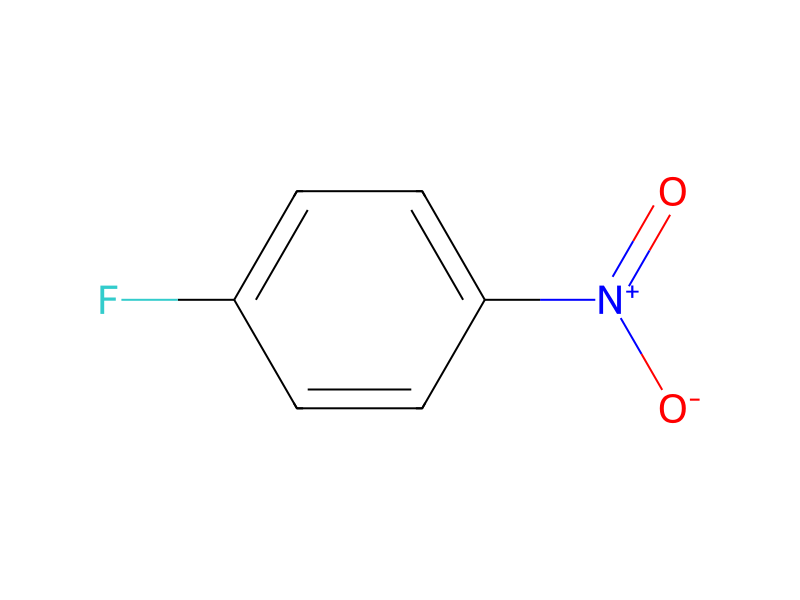
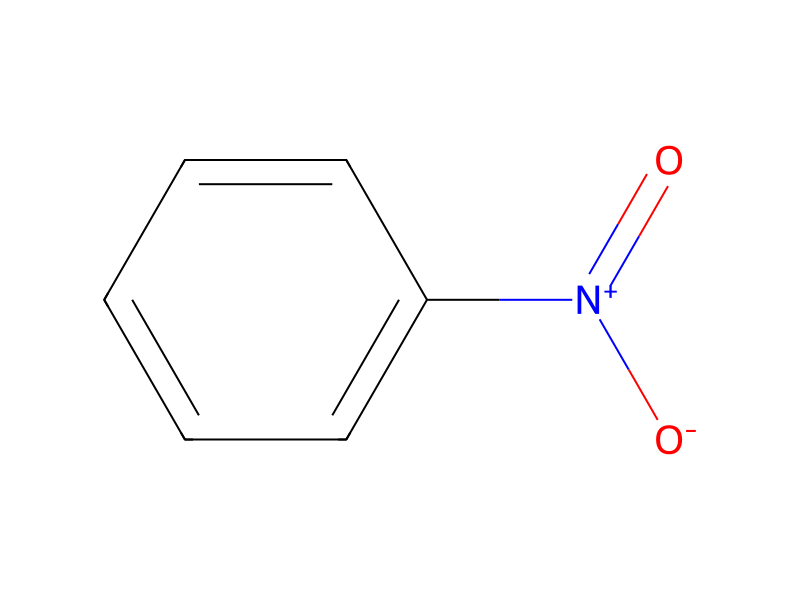
p-Fluoronitrobenzene → Nitrobenzene
Reaction equation

FC1C(C(C(F)(F)F)(C(F)(F)F)C(F)(F)F)=C(O)C(F)=C(F)C=1F.F[C:26]1[CH:31]=[CH:30][C:29]([N+:32]([O-:34])=[O:33])=[CH:28][CH:27]=1>C(COC)OC>[N+:32]([C:29]1[CH:30]=[CH:31][CH:26]=[CH:27][CH:28]=1)([O-:34])=[O:33]Participants
Reactant 2

Product 1
Reagents, catalysts & solvents 1

Procedure
Yet another alternative strategy for the formation of calixarene conjugates involves first derivatizing pre-calixarene monomers followed by the formation of a calixarene structure. For example, perfluoro-tert-butylphenol monomers may be prepared by reacting p-fluoro-nitrobenzene with Cs+C(CF3)3 -- in monoglyme to yield nitrobenzene, followed by reduction of the nitro group to an amino group, diazotization of the amino group to yield a diazonium salt, and hydrolysis to yield a hydroxy group. In the same manner that 4-tert-butylphenol is reacted with formaldehyde to yield a simple calixarene, 4-perfluoro-tert-butylphenol may be reacted with formaldehyde to yield a calixarene conjugate wherein the imaging moiety is perfluoro-tert-butyl (--C(CF3)3) in the 4-position.
Sources & evidence
- ORD record
- ord-176ab9697c0b4ef094522d7378f1a5e6
- Source dataset
- uspto-grants-1998_12
- Patent number
- US05846515
Reaction notes
Loading…