Fluorobenzene → 1-Acetyl-4-(4-fluorobenzoyl)piperidine
Reaction equation

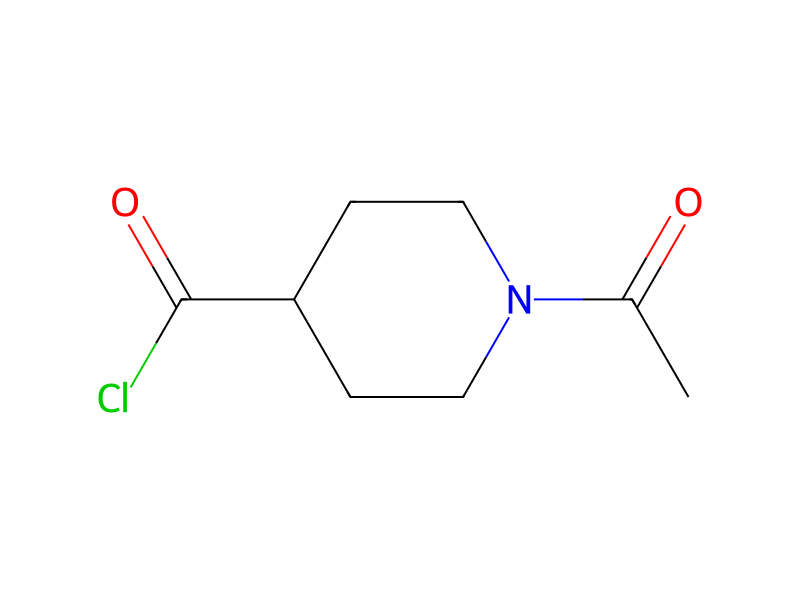
[Cl-].[Al+3].[Cl-].[Cl-].[C:5]([N:8]1[CH2:16][CH2:15][CH:11]([C:12](Cl)=[O:13])[CH2:10][CH2:9]1)(=[O:7])[CH3:6].[F:17][C:18]1[CH:23]=[CH:22][CH:21]=[CH:20][CH:19]=1>>[C:5]([N:8]1[CH2:16][CH2:15][CH:11]([C:12](=[O:13])[C:21]2[CH:22]=[CH:23][C:18]([F:17])=[CH:19][CH:20]=2)[CH2:10][CH2:9]1)(=[O:7])[CH3:6]Participants



Procedure
A mixture of 93 g (0.7 mole) of aluminum chloride in 150 ml of fluorobenzene was stirred while 70 g (0.37 mole) of 1-acetylisonipecotic acid chloride was added in small portions. After the addition was complete, the mixture was heated at reflux for one hour. The mixture was poured onto ice, and the two resulting layers were separated. The aqueous layer was extracted twice with chloroform and the chloroform extracts were added to the fluorobenzene which was separated previously. The organic solution was dried over anhydrous sodium sulfate and filtered. The filtrate was concentrated, and 73.7 g (80%) of 1-acetyl-4-(p-fluorobenzoyl)piperidine was obtained as a crystalline residue. Recrystallization from ligroin-isopropyl ether gave a white, crystalline product melting at 75°-78° C.
Workup
- additionwas added in small portions
- additionAfter the addition
- temperaturethe mixture was heated
- temperatureat reflux for one hour
- additionThe mixture was poured onto ice
- customthe two resulting layers were separated
- extractionThe aqueous layer was extracted twice with chloroform
- additionthe chloroform extracts were added to the fluorobenzene which
- customwas separated previously
- dry with materialThe organic solution was dried over anhydrous sodium sulfate
- filtrationfiltered
- concentrationThe filtrate was concentrated
Sources & evidence
- ORD record
- ord-21ce9dee009149d2ab694f34ac5109b4
- Source dataset
- uspto-grants-1991_12
- Patent number
- US05070087
Reaction notes
Loading…