Butanedioic acid--ethane-1,2-diol (1/1) → Ethylene
Reaktionsgleichung

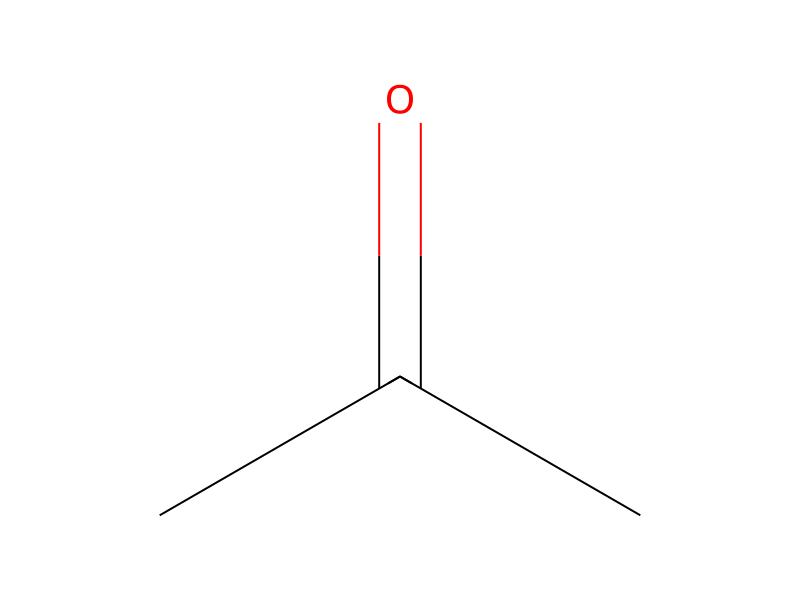
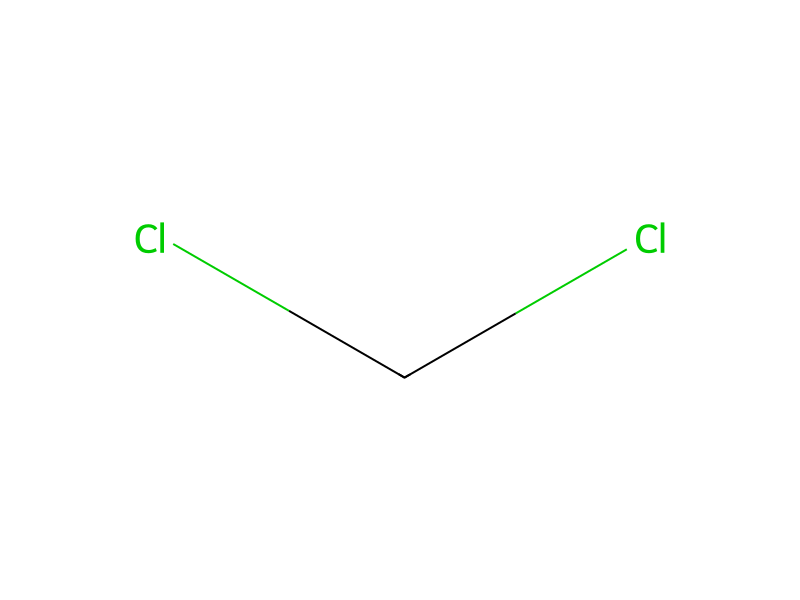
[CH2:1]([C:6]([OH:8])=[O:7])[CH2:2]C(O)=O.[CH2:9](O)[CH2:10][OH:11]>ClCCl.C=CCOC(C1C(C(OCC=C)=O)=CC=CC=1)=O.CC(C)=O.[O-2].[O-2].[Ti+4]>[CH2:1]=[CH2:2].[CH:10]([OH:11])=[CH2:9].[C:6]([O:8][CH:9]=[CH2:10])(=[O:7])[CH3:1]Komponenten
Edukt 1

Produkt 3


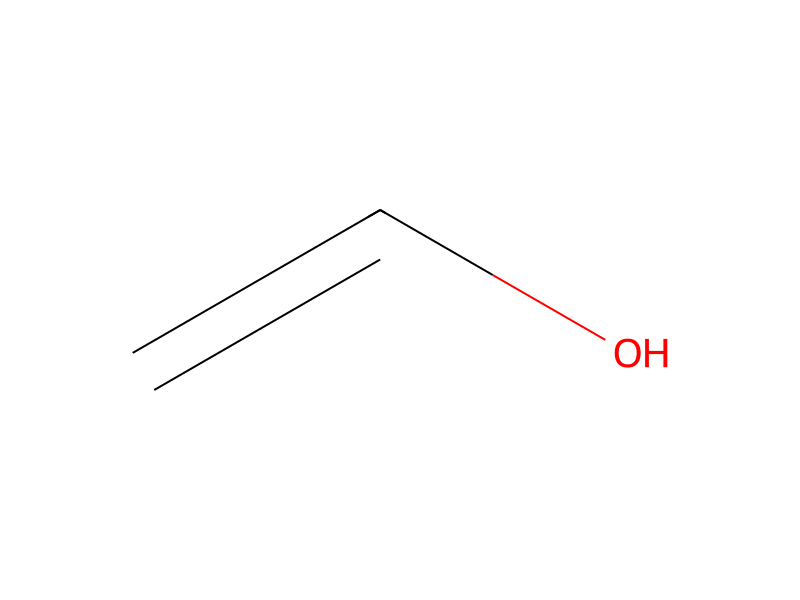
Reagenzien, Katalysatoren, Lösungsmittel 4


Versuchsvorschrift
Illustrative examples of ink receiving layers of, for example, a thickness of from about 2 to about 25 microns, preferably for each side of the pigmented layer and in contact with the pigmented layer comprised of polymer resin bider and pigment, preferably an inorganic pigment such as titanium dioxide dispersed therein, include poly(ethylene succinate) (available from Scientific Polymer Products) in dichloromethane, poly(diallyl phthalate) (Scientific Polymer Products) in acetone, poly(diallylisophthalate) (Scientific Polymer Products) in acetone, cellulose propionate in acetone (Scientific Polymer Products), ethylene-vinyl acetatevinyl alcohol terpolymer (with ethylene contents of 40 percent by weight, vinyl acetate content of 40 percent by weight, and vinyl alcohol content of 20 percent by weight in acetone) which can be obtained by partial hydrolysis of ethylene vinyl acetate copolymer with vinyl acetate content of 60 percent by weight (available from Scientific Polymer Products); blends of chlorinated rubber (chlorine content 65 percent by weight, available from Scientific Polymer Products) from about 10 to about 90 percent by weight and ethylene/vinyl acetate copolymer (vinyl acetate content 40 percent by weight) from about 90 to about 10 percent by weight in dichloromethane as well as in toluene; blends of chlorinated rubber (chlorine content 65 percent by weight, Scientific Polymer Products) from about 10 to about 90 percent by weight and poly(caprolactone) (PLC-700, available from Union Carbide) from about 90 to about 10 percent by weight in dichloromethane; blends of chlorinated rubber (chlorine content 65 percent by weight, Scientific Polymer Products) from about 10 to about 90 percent by weight and poly(chloroprene) (Scientific Polymer Products) from about 90 to about 10 percent by weight in dichlormethane; blends of poly(propylene) chlorinated (chlorine content 65 percent by weight, Scientific Polymer Products) from about 10 to about 90 percent by weight and ethylene/vinyl acetate (vinyl acetate content 40 percent by weight, Scientific Polymer Products) from about 90 to about 10 percent by weight in dichloromethane as well as in toluene; blends of poly(propylene) chlorinated (chlorine content 65 percent by weight, Scientific Polymer Products) from about 10 to about 90 percent by weight and poly(caprolactone) (PLC-700, Union Carbide) from about 90 to about 10 percent by weight in dichloromethane; blends of poly(propylene) chlorinated (chlorine content 65 percent by weight, Scientific Polymer Products) from about 10 to about 90 percent by weight and poly(chloroprene) (Scientific Polymer Products) from about 90 to about 10 percent by weight in dichlormethane; blends of poly(ethylene) chlorinated (chlorine content 48 percent by weight, Scientific Polymer Products) from about 10 to about 90 percent by weight and ethylene/vinyl acetate copolymer (vinyl acetate 40 percent by weight, Scientific Polymer Products) from about 90 to about 10 percent by weight in dichloromethane as well as in toluene; blends of poly(ethylene) chlorinated (chlorine content 42 percent by weight, Scientific Polymer Products) and poly(caprolactone) (PLC-700, available from Union Carbide) from about 90 to about 10 percent by weight dichlormethane; blends of poly(ethylene) chlorinated (chlorine content 36 percent by weight, Scientific Polymer Products) from about 10 to about 90 percent by weight and poly(chloroprene) (Scientific Polymer Products) from about 90 to about 10 percent by weight in dichloromethane; blends of poly(ethylene) chlorosulfonated (chlorine content 43 percent by weight, sulfur content 1.1 percent by weight as chlorosulfone, available from Scientific Polymer Products) from about 10 to about 90 percent by weight and ethylene/vinyl acetate copolymer (vinyl acetate content, 70 percent by weight, available from Scientific Polymer Products) from about 90 to about 10 percent by weight; blends of from about 10 to about 90 percent by weight in water of poly(ethylene oxide) (POLY OX WSRN-3000 from Union Carbide) and from about 90 to about 10 percent by weight of a component selected from the group consisting of (1) hydroxypropyl methyl cellulose (methocel K35LV, available from Dow Chemical Company), (2) vinylmethyl ether/maleic acid copolymer (Gantzez S-95, available from GAF Corporation); (3) acrylamide/acrylic acid copolymer (Scientific Polymer Products), (4) carboxy methylhydroxyethyl cellulose sodium salt (CMHEC 43H, 37L, available from Hercules Chemical Company, CMHEC 43H is a high molecular weight polymer with carboxymethyl cellulose (CMC)/hydroxyethyl cellulose (HEC) ratio of 4:3, CMHEC 37L is a low molecular weight polymer with CMC/HEC ratio of 3:7); (5) hydroxyethyl cellulose (Natrosol 250LR, available from Hercules); (6) water soluble ethylhydroxyethyl cellulose (Bermocoll, available from Berol kem, AB, Sweden); (7) cellulose sulfate (Scientific Polymer Products); (8) poly(vinyl alcohol) (Scientific Polymer Products); (9) poly(vinyl pyrrolidone) (GAF Corporation), (10) hydroxybutyl methyl cellulose (Dow Chemical Company); (11) hydroxypropyl cellulose (Klucel Type E, available from Hercules); (12) poly(2-acrylamido-2-methyl propane sulfonic acid) (Scientific Polymer Products); (13) methyl cellulose (Dow Chemical Company); (14) hydroxyethylmethyl cellulose (available as HEM from British Celanese Ltd. and Tylose MH, MHK from Kalle A.G.); (15) poly(diethylene triamine-coadipic acid) (Scientific Polymer Products); (16) poly(imidazoline) quaternized (Scientific Polymer Products); (17) poly(ethylene imine) epichlorohydrin modified (Scientific Polymer Products); (18) poly(N,N-dimethyl-3,5-dimethylene piperidinium chloride) (Scientific Polymer Products); or (19) poly(ethylene imine) ethoxylated (Scientific Polymer Products).
Quellen und Nachweise
- ORD-Eintrag
- ord-34a1bb587d4d4164bc9ee93ac56d80a1
- Quelldatensatz
- uspto-grants-1991_12
- Patentnummer
- US05075153
Notizen zur Reaktion
Wird geladen…