Diisopropyl Ether → Acetone diisopropyl ether
Reaction equation

[CH:1]([O:4][CH:5]([CH3:7])[CH3:6])([CH3:3])[CH3:2]>CC(C)=O>[CH3:2][C:1]([CH3:3])=[O:4].[CH:1]([O:4][CH:5]([CH3:7])[CH3:6])([CH3:3])[CH3:2]Participants
Reactant 1
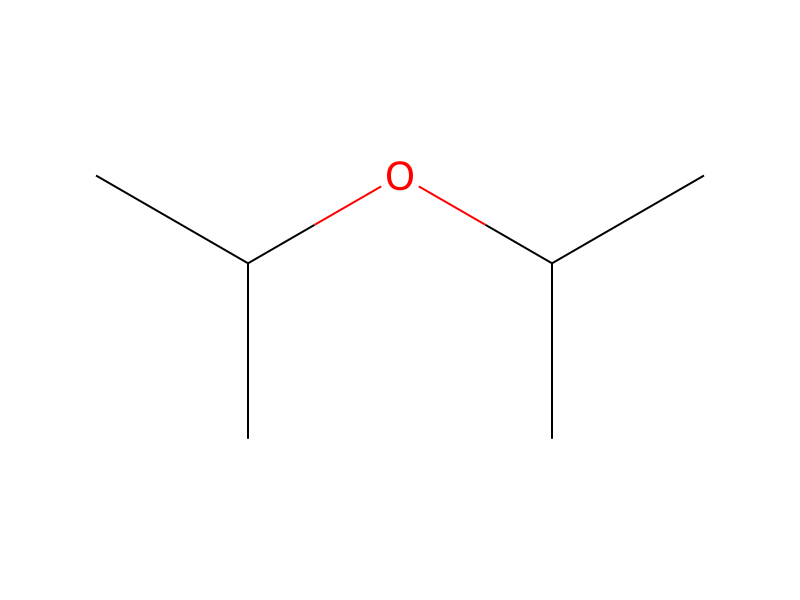
Product 1

Reagents, catalysts & solvents 1
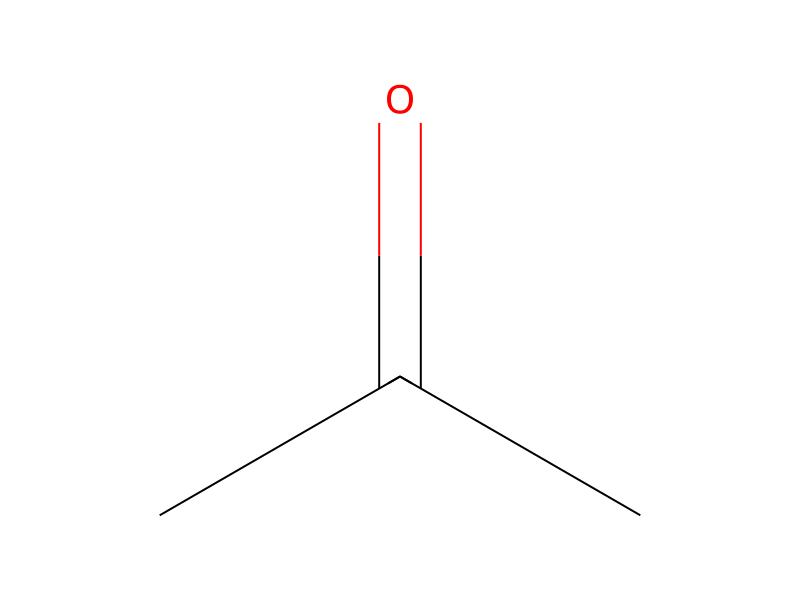
Procedure
One of the commercially important ways to manufacture acetone is by the catalytic dehydrogenation of isopropanol. Since the acetone (b.p.=56.15° C.) does not form an azeotrope with isopropanol (b.p.=82.4° C.), the acetone is relatively easy to separate from the unreacted isopropanol by rectification. However a concurrent reaction takes place in which some of the isopropanol dehydrates to form isopropyl ether (b.p.=69° C.). Acetone and isopropyl ether form a minimum azeotrope boiling at 54.2° C. at one Atm. pressure and containing 61 wt.% acetone, 39 wt. % isopropyl ether. It is therefore impossible to produce pure acetone from acetone-isopropyl ether mixtures by rectification because the lower boiling azeotrope will always come off overhead as the initial product. Any mixture of acetone and isopropyl ether subjected to rectification at one atmosphere pressure will produce an overhead product boiling at 54.2° C. and containing 61% acetone, 39% isopropyl ether. Extractive distillation would be an attractive method of effecting the separation of acetone from isopropyl ether if agents can be found that (1) will break the acetone-isopropyl ether azeotrope and (2) are easy to recover from the acetone, that is, form no azeotrope with acetone and boil sufficiently above acetone to make the separation by rectification possible with only a few theoretical plates.
Sources & evidence
- ORD record
- ord-5a6ff4624a76419893e067892b52e3d3
- Source dataset
- uspto-grants-1984_07
- Patent number
- US04459179
Reaction notes
Loading…