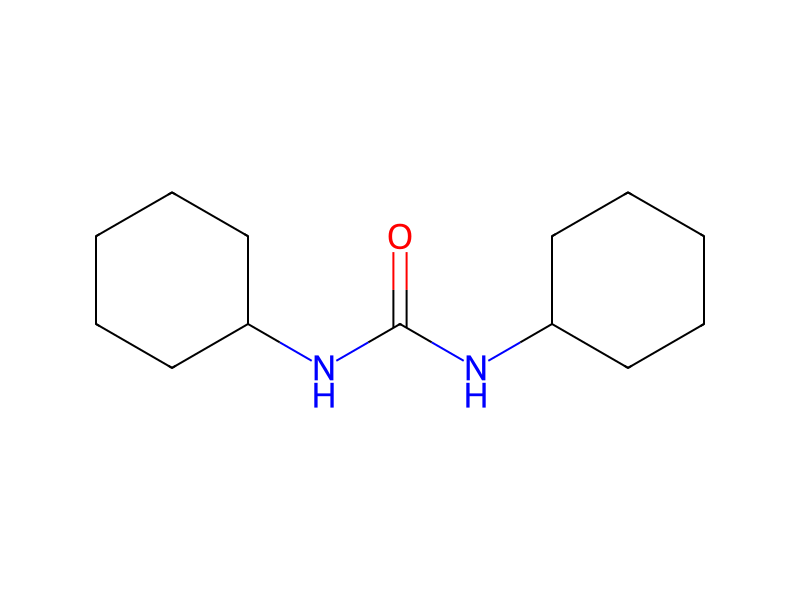
Dicyclohexylcarbodiimide → N,N'-Dicyclohexylurea
Reaction equation

N(CC[O:6]CCOCCOCCN)=[N+]=[N-].[CH:16]1([N:22]=[C:23]=[N:24][CH:25]2[CH2:30][CH2:29][CH2:28][CH2:27][CH2:26]2)[CH2:21][CH2:20][CH2:19][CH2:18][CH2:17]1.C(O)(=O)CC[C@H](NC(C1C=CC(NCC2N=C3C(N=C(NC3=O)N)=NC=2)=CC=1)=O)C(O)=O>CS(C)=O.N1C=CC=CC=1>[C:23]([NH:22][CH:16]1[CH2:17][CH2:18][CH2:19][CH2:20][CH2:21]1)([NH:24][CH:25]1[CH2:30][CH2:29][CH2:28][CH2:27][CH2:26]1)=[O:6]Participants
Reactant 3



Product 1
Reagents, catalysts & solvents 2


Procedure
2-(2-(2-(2-Azidoethoxy)ethoxy)ethoxy)ethanamine (0.3 ml, 1.2, equiv.) (commercially available or prepared as described by Schwabacher et al., J. Org. Chem. 1998, 63: 1727) and dicyclohexylcarbodiimide (DCC) (650 mg, 2.5 equiv.) were added to a solution of folic acid dehydrate (600 mg, 1.26 mmol) in DMSO (20 ml) and pyridine (10 ml). The reaction mixture was stirred overnight, in darkness, at ambient temperature, giving rise to the formation of a precipitate of dicyclohexylurea (DCU). After removal of the precipitate, filtrate was poured into a solution of anhydrous ether (400 ml) cooled to 0° C. The yellow precipitate thus obtained was recovered by filtration, then washed with Et2O to remove traces of DMSO. An HPLC analysis of the precipitate (Method 1) showed that the two isomers 6a and 6b were obtained in a ratio of 7/3. The solid (812 mg) was dissolved in a solution (8 ml) 8:2:0.3:0.3 H2O/ACN/DMSO/Et3N, and purified by reverse phase preparative HPLC (Method 2). The fraction containing the inseparable isomers 6a and 6b was concentrated under reduced pressure. The residue was then dissolved in methanol under reflux and poured into a solution of Et2O cooled to 0° C. The precipitate was recovered by filtration and washed with Et2O to yield a yellow powder (240 mg, 30%).
Sources & evidence
- ORD record
- ord-051791e7966746b0b1e5b76d420a2e81
- Source dataset
- uspto-grants-2015_04
- Patent number
- US09000135B2
Reaction notes
Loading…