Triethylamine → HCID 86710135, compound
Reaction equation

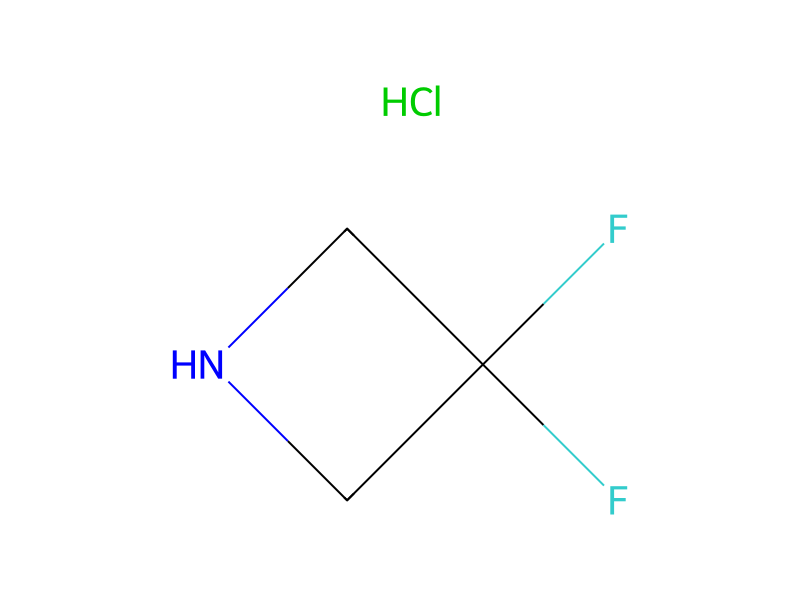
[Br:1][C:2]1[CH:7]=[CH:6][N:5]2[C:8]([S:14](Cl)(=[O:16])=[O:15])=[C:9]([CH:11]([CH3:13])[CH3:12])[N:10]=[C:4]2[CH:3]=1.Cl.[F:19][C:20]1([F:24])[CH2:23][NH:22][CH2:21]1.C(N(CC)CC)C.C(=O)([O-])O.[Na+]>C(#N)C>[Br:1][C:2]1[CH:7]=[CH:6][N:5]2[C:8]([S:14]([N:22]3[CH2:23][C:20]([F:24])([F:19])[CH2:21]3)(=[O:16])=[O:15])=[C:9]([CH:11]([CH3:13])[CH3:12])[N:10]=[C:4]2[CH:3]=1Participants
6





Conditions
- Temperature
- 50 °C
Procedure
7-Bromo-2-isopropylimidazo[1,2-a]pyridine-3-sulfonylchloride (500 mg, 1.481 mmol) obtained in step 1 was dissolved in acetonitrile (5.0 mL), and the solution was stirred at 50° C. for 30 minutes after adding 3,3-difluoroazetidine hydrochloride (230 mg, 1.78 mmol) and triethylamine (0.413 ml, 2.96 mmol). The reaction mixture was allowed to cool to room temperature, and a sodium hydrogen carbonate aqueous solution was added. The precipitated solid was collected by filteration to give 7-bromo-3-(3,3-difluoroazetidin-1-ylsulfonyl)-2-isopropylimidazo[1,2-a]pyridine (546 mg, yield 94%).
Workup
- temperatureto cool to room temperature
- customThe precipitated solid was collected by filteration
Sources & evidence
- ORD record
- ord-f809d4ca10604c079b61ee048ebee3c2
- Source dataset
- uspto-grants-2015_04
- Patent number
- US09000186B2
Reaction notes
Loading…