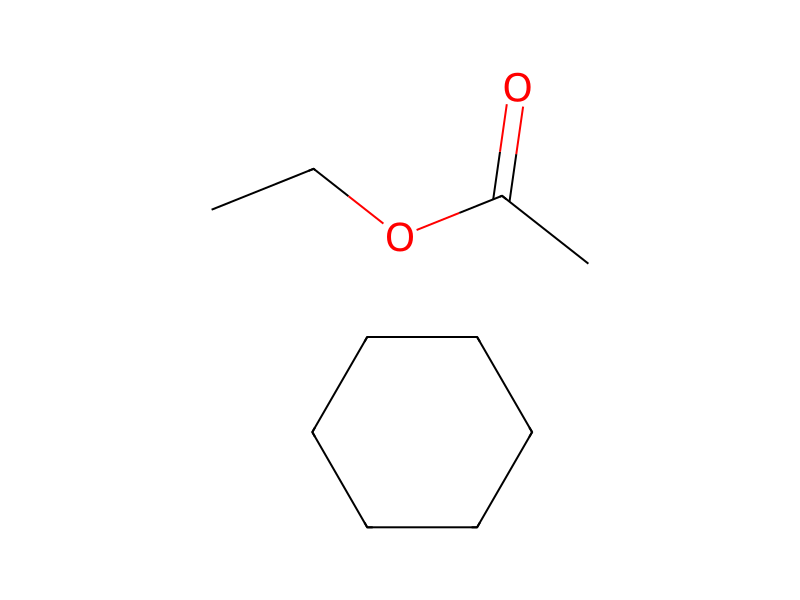
Cyclohexane ethylacetate → Methyl [1-(3-amino-4-fluorophenyl)cyclopropyl]acetate
Reaction equation

C([N:8](CC1C=CC=CC=1)[C:9]1[CH:10]=[C:11]([C:16]2([CH2:19][C:20]([O:22][CH3:23])=[O:21])[CH2:18][CH2:17]2)[CH:12]=[CH:13][C:14]=1[F:15])C1C=CC=CC=1.C1CCCCC1.C(OCC)(=O)C>[Pd].C(O)C>[NH2:8][C:9]1[CH:10]=[C:11]([C:16]2([CH2:19][C:20]([O:22][CH3:23])=[O:21])[CH2:17][CH2:18]2)[CH:12]=[CH:13][C:14]=1[F:15]Participants
5




Procedure
At room temperature, 200 mg of palladium on carbon (10%) were added to a solution of 2.1 g (5.2 mmol) of methyl {1-[3-(dibenzylamino)-4-fluorophenyl]cyclopropyl}acetate in 100 ml of ethanol, and the mixture was hydrogenated at atmospheric pressure for 12 h. After the reaction had gone to completion (monitored by TLC; mobile phase cyclohexane/ethyl acetate 1:1), the reaction solution was filtered through kieselguhr and the filtrate was concentrated under reduced pressure. The crude product was purified chromatographically on silica gel (mobile phase cyclohexane/ethyl acetate 10:1). This gave 647 mg (2.9 mmol, 56% of theory) of the title compound.
Workup
- filtrationthe reaction solution was filtered through kieselguhr
- concentrationthe filtrate was concentrated under reduced pressure
- customThe crude product was purified chromatographically on silica gel (mobile phase cyclohexane/ethyl acetate 10:1)
Sources & evidence
- ORD record
- ord-8637bce0a7cf463594351e7d9aec2699
- Source dataset
- uspto-grants-2015_04
- Patent number
- US09018414B2
Reaction notes
Loading…