Benzyl 2-(triphenyl-lambda5-phosphanylidene)acetate → Benzyl (oxetan-3-ylidene)acetate
Reaction equation

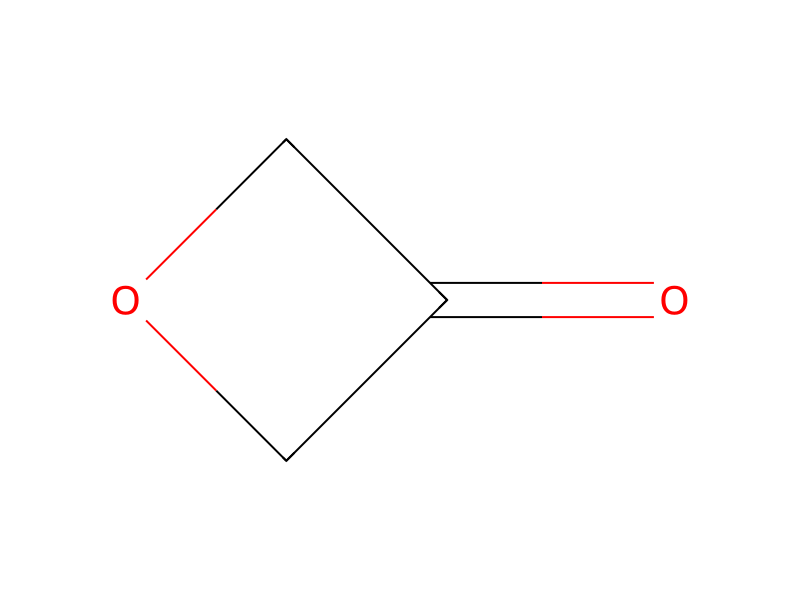
[O:1]1[CH2:4][C:3](=O)[CH2:2]1.C1(P(=[CH:25][C:26]([O:28][CH2:29][C:30]2[CH:35]=[CH:34][CH:33]=[CH:32][CH:31]=2)=[O:27])(C2C=CC=CC=2)C2C=CC=CC=2)C=CC=CC=1>ClCCl>[O:1]1[CH2:2][C:3](=[CH:25][C:26]([O:28][CH2:29][C:30]2[CH:35]=[CH:34][CH:33]=[CH:32][CH:31]=2)=[O:27])[CH2:4]1Participants
Reactant 2

Product 1

Reagents, catalysts & solvents 1

Procedure
Under argon and at 0° C., 3.0 g (41.63 mmol) of oxetan-3-one (CAS Reg.-No. 6704-31-0) were dissolved in 50 ml of dichloromethane, and 18.8 g (45.79 mmol) of benzyl (triphenyl-λ5-phosphanylidene)acetate were then added. The reaction mixture was then slowly warmed to room temperature and stirred for another 15 minutes. The reaction solution was then concentrated to dryness. The residue was taken up in 25 ml of diethyl ether and stirred, and the mixture was kept at 4° C. for 12 h. The precipitated triphenylphosphine oxide was filtered off and the filtrate was concentrated to dryness. The crude product obtained was purified chromatographically on silica gel (mobile phase cyclohexane/ethyl acetate 4:1→1:1). This gave 4.2 g (20.57 mmol, 49% of theory) of the title compound.
Workup
- concentrationThe reaction solution was then concentrated to dryness
- stirringstirred
- waitthe mixture was kept at 4° C. for 12 h
- filtrationThe precipitated triphenylphosphine oxide was filtered off
- concentrationthe filtrate was concentrated to dryness
Sources & evidence
- ORD record
- ord-9a897c4ba3364f69a0ede222aebb2be8
- Source dataset
- uspto-grants-2015_04
- Patent number
- US09018414B2
Reaction notes
Loading…