Sodium hydride → rac-Ethyl 2-(3-bromo-4-fluorophenyl)-trans-cyclopropanecarboxylate
Reaktionsgleichung

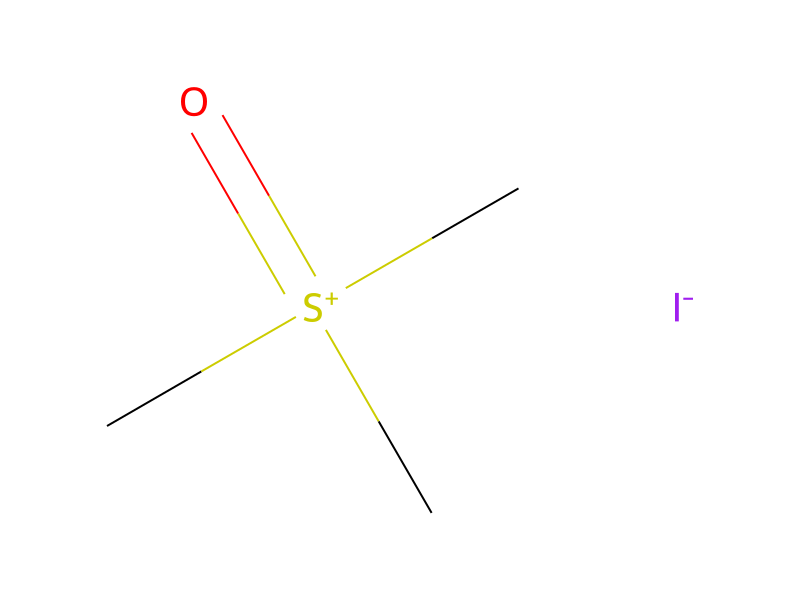
[H-].[Na+].[I-].[CH3:4][S+](C)(C)=O.[Br:9][C:10]1[CH:11]=[C:12]([CH:17]=[CH:18][C:19]([O:21][CH2:22][CH3:23])=[O:20])[CH:13]=[CH:14][C:15]=1[F:16]>CS(C)=O>[Br:9][C:10]1[CH:11]=[C:12]([C@@H:17]2[CH2:4][C@H:18]2[C:19]([O:21][CH2:22][CH3:23])=[O:20])[CH:13]=[CH:14][C:15]=1[F:16]Komponenten
5
Edukt 3


Produkt 1

Reagenzien, Katalysatoren, Lösungsmittel 1

Reaktionsbedingungen
- Temperatur
- 50 °C
Versuchsvorschrift
Under argon, 381 mg (9.52 mmol) of sodium hydride (60% in paraffin oil) were initially charged in 20 ml of DMSO, and 2.1 g (9.52 mmol) of trimethylsulphoxonium iodide were added in one portion at RT. After the evolution of gas had ceased, 2.0 g (7.3 mmol) of ethyl 3-(3-bromo-4-fluorophenyl)acrylate, dissolved in 10 ml of DMSO, were slowly added dropwise. The reaction mixture was heated at 50° C. overnight, then cooled to RT and, without further work-up, purified by flash chromatography on silica gel (mobile phase isohexane/ethyl acetate 100:1). This gave 907 mg (43% of theory) of the target product.
Aufarbeitung
- additionwere slowly added dropwise
- temperaturecooled to RT and, without further work-up
- custompurified by flash chromatography on silica gel (mobile phase isohexane/ethyl acetate 100:1)
Quellen und Nachweise
- ORD-Eintrag
- ord-5f2a185aa369410ca150ee31180e1454
- Quelldatensatz
- uspto-grants-2015_04
- Patentnummer
- US09018414B2
Notizen zur Reaktion
Wird geladen…