Dichloromethane → HCID 86707656, compound
Reaction equation

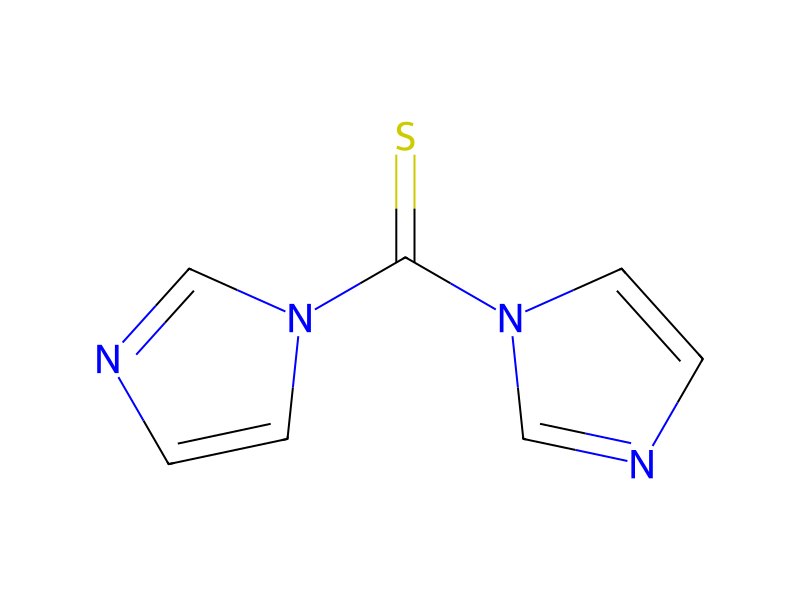
[Br:1][C:2]1[C:8]([C:9]([F:12])([F:11])[F:10])=[CH:7][C:5]([NH2:6])=[CH:4][C:3]=1[Cl:13].ClCCl.[C:17](N1C=CN=C1)(N1C=CN=C1)=[S:18]>>[Br:1][C:2]1[C:8]([C:9]([F:10])([F:11])[F:12])=[CH:7][C:5]([N:6]=[C:17]=[S:18])=[CH:4][C:3]=1[Cl:13]Participants
4



Procedure
To a suspension of 4-bromo-3-chloro-5-(trifluoromethyl)aniline (15 g, 54.7 mmol, Eq: 1.00) in dichloromethane (13.2 g, 10.0 ml, 155 mmol, Eq: 25.3) at 0, was added 1,1′-thiocarbonyldiimidazole (11.7 g, 65.6 mmol, Eq: 1.2) The reaction was gradually warmed to room temperature and stirred overnight. The reaction was concentrated and chromatographed (220 g Redisep, 5 to 15% dichloromethane/hexane) to give 13.84 g (80%) pale yellow oil.
Workup
- concentrationThe reaction was concentrated
- customchromatographed (220 g Redisep, 5 to 15% dichloromethane/hexane)
- customto give 13.84 g (80%)
Sources & evidence
- ORD record
- ord-0977515ecc594f118e7fd53124999d74
- Source dataset
- uspto-grants-2016_08
- Patent number
- US09428469B2
Reaction notes
Loading…