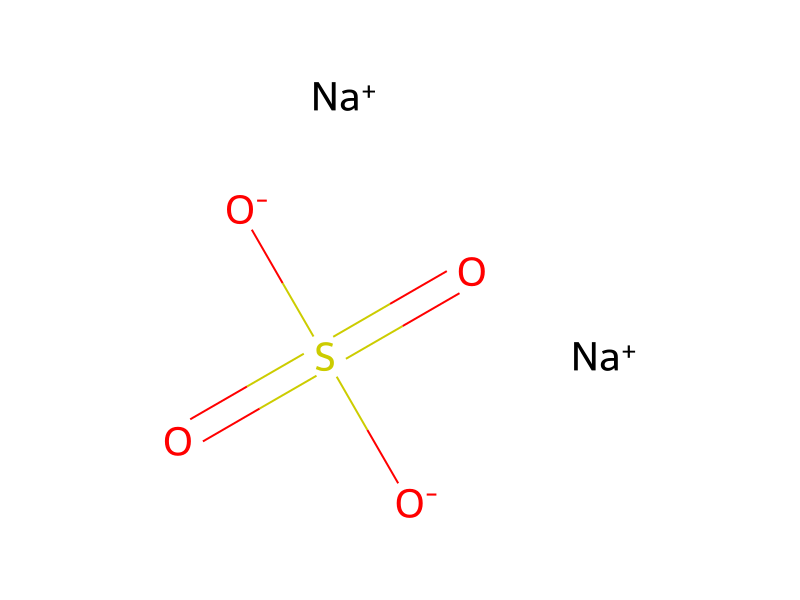
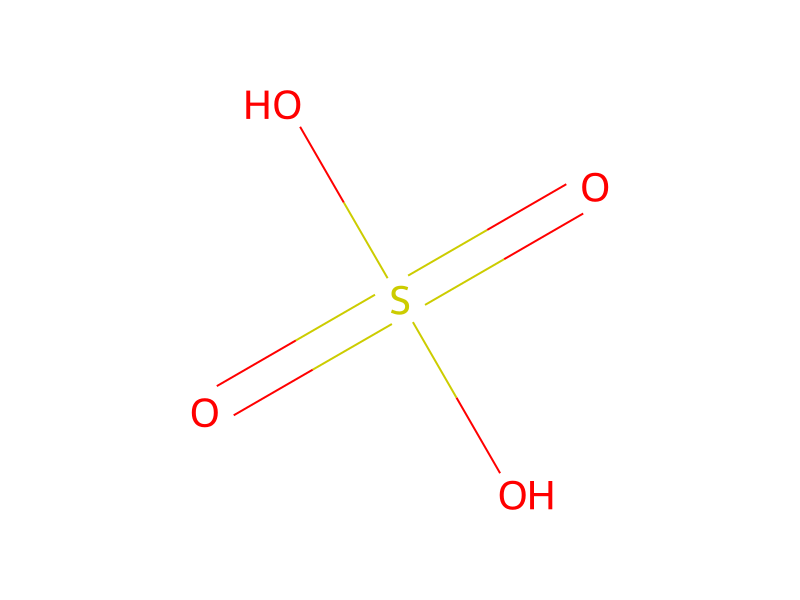
Sodium Sulfate → Sulfuric Acid
Reaction equation

[S:1]([OH:5])([OH:4])(=[O:3])=[O:2].[Na+:6].[S:7]([O-:11])([O-:10])(=[O:9])=[O:8].S(O)(O)(=O)=O.[Na+].S([O-])([O-])(=O)=O.[Na+].[Na+]>>[S:1]([O-:5])([O-:4])(=[O:3])=[O:2].[Na+:6].[Na+:6].[OH:10][S:7]([OH:11])(=[O:9])=[O:8]Participants

Procedure
Referring to FIG. 1, sodium chlorate, sulfuric acid and methanol are supplied to a chlorine dioxide generator 1, preferably operated according to any of the SVP®-lite or the R8 processes. In the generator 1 an acid aqueous reaction medium containing sodium ions, sulfate ions and chlorate ions is maintained at subatmospheric pressure at a temperature sufficient to effect boiling. Chlorate ions are reduced by methanol to form chlorine dioxide gas which is withdrawn together with evaporated water. Solid sodium sesqui sulfate precipitates and is separated from the reaction medium on a first filter 2 and transferred to a mixing tank 3 in which it is contacted with an acid aqueous solution containing sodium sulfate to form a slurry, the acidity of the solution preferably being from about 5.5 to about 6.5N. In the mixing tank 3 the solid sodium sesqui sulfate is partially converted to neutral sodium sulfate which is separated from the aqueous solution on a second filter 4 on which the filter cake is washed with sufficient water to obtain solid sodium sulfate containing less than about 2% by weight of H2SO4. The acid aqueous solution and the spent washing water are mixed to form an acid filtrate 5 which is transferred to a filtrate tank 6. The washing water can be added in one or several steps. It is also possible to wash in a first step with acid filtrate and in a second step with water. An acid filtrate stream 7 is pumped to a device 8, for example a control valve, dividing the acid filtrate 7 to one stream 9 leading to the mixing tank 3, and another stream 10 leading back to the chlorine dioxide generator 1. The stream 10 preferably constitutes from about 10 to about 20% of the total acid filtrate stream 7. The amount of water added to the mixing tank 3 is preferably from about 0.28 to about 0.45 kg per kg sodium sesqui sulfate. The amount of water added to the second filter 4 for washing is preferably from about 0.04 to about 0.1 kg per kg sodium sesqui sulfate. Both the filters 2, 4 are preferably rotating drum filter operating with vacuum inside the drums. It is preferred that at least the second filter 4 is a bottom feed filter without any cyclone or similar device for pre-concentrating the slurry, which enables more stable operation of the entire process than if a conventional top feed filter is used. Preferably also the first filter 2 is a bottom feed filter of the same or similar construction. The entire process is preferably operated continuously.
Workup
- customis withdrawn together with evaporated water
- customSolid sodium sesqui sulfate precipitates
- customis separated from the reaction medium on
- filtrationa first filter 2
- additioncontaining sodium sulfate
- customto form a slurry
- customis separated from the aqueous solution on
- filtrationa second filter 4 on which the filter cake
- washis washed with sufficient water
Sources & evidence
- ORD record
- ord-11ac6140d7fa4ba5b138882c46b13509
- Source dataset
- uspto-grants-1997_10
- Patent number
- US05674466
Reaction notes
Loading…