Benzyl Alcohol → ((4-Bromobutoxy)methyl)benzene
Reaction equation
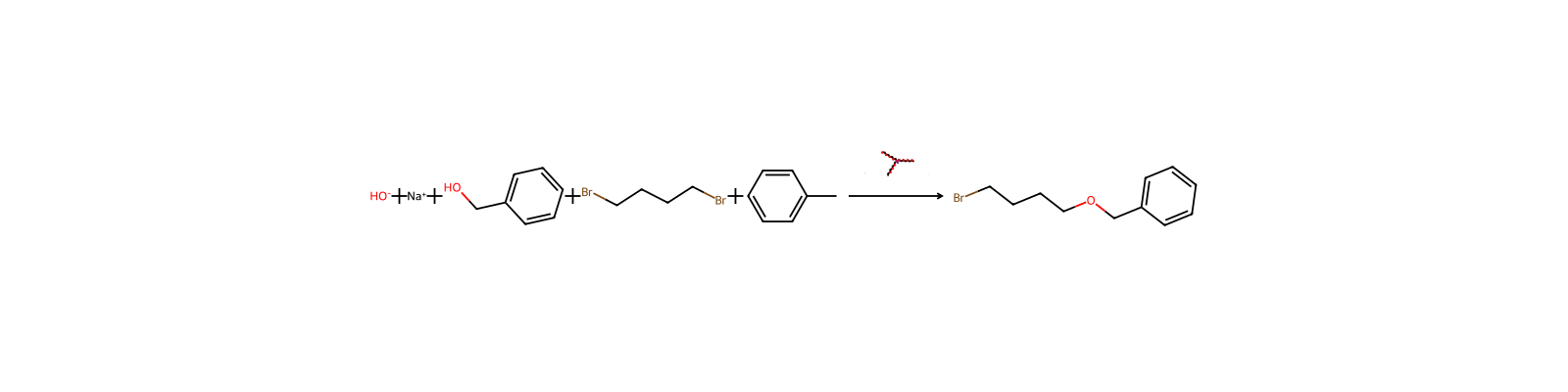
[OH-].[Na+].[CH2:3]([OH:10])[C:4]1[CH:9]=[CH:8][CH:7]=[CH:6][CH:5]=1.[Br:11][CH2:12][CH2:13][CH2:14][CH2:15]Br.C1(C)C=CC=CC=1>O.CCCCCCCC[N+](CCCCCCCC)(CCCCCCCC)C.[Cl-]>[CH2:3]([O:10][CH2:15][CH2:14][CH2:13][CH2:12][Br:11])[C:4]1[CH:9]=[CH:8][CH:7]=[CH:6][CH:5]=1Participants







Procedure
To a warm mixture of sodium hydroxide (240 g, 6 mol) in 260 mL water there is added benzylalcohol (174 g, 1.61 mol), 1,4-dibromobutane (624 g, 2.88 mol), 10 g aliquat 336, and 150 mL toluene with good stirring. The temperature of the reaction mixture rises slowly to about 60° C. and is kept below this temperature by slight cooling. When the temperature of the mixture drops the cooling bath is removed and the reaction mixture is stirred for an additional hour, then poured in 500 mL water. The product is extracted with 750 mL toluene and the organic layer is washed with 3×500 mL water, then dried, evaporated and purified by bulb-to-bulb distillation at 0,2 mmHg. This gives first 1,4-dibromobutane, then an intermediate fraction and then the product. After redistillation of the intermediate fraction there is obtained a total of 260 g of the product (1.07 mol, 66% yield, probably contaminated with some 1,4-dibenzyloxycompound) with bp 130° C. (0.2 mmHg). The product is used as such in the next step. 1H-NMR (CCl4): δ 1.4-2.1 (m, 4H), 3.3 (2t, 4H), 4.3 (s, 2II), 7.2 (s, 5H).
Workup
- customrises slowly to about 60° C.
- customis removed
- additionpoured in 500 mL water
- extractionThe product is extracted with 750 mL toluene
- washthe organic layer is washed with 3×500 mL water
- customdried
- customevaporated
- distillationpurified by bulb-to-bulb distillation at 0,2 mmHg
- distillationAfter redistillation of the intermediate fraction there
Sources & evidence
- ORD record
- ord-a6006dfd712e4f76a4152aff495c427e
- Source dataset
- uspto-grants-1997_10
- Patent number
- US05677432
Reaction notes
Loading…