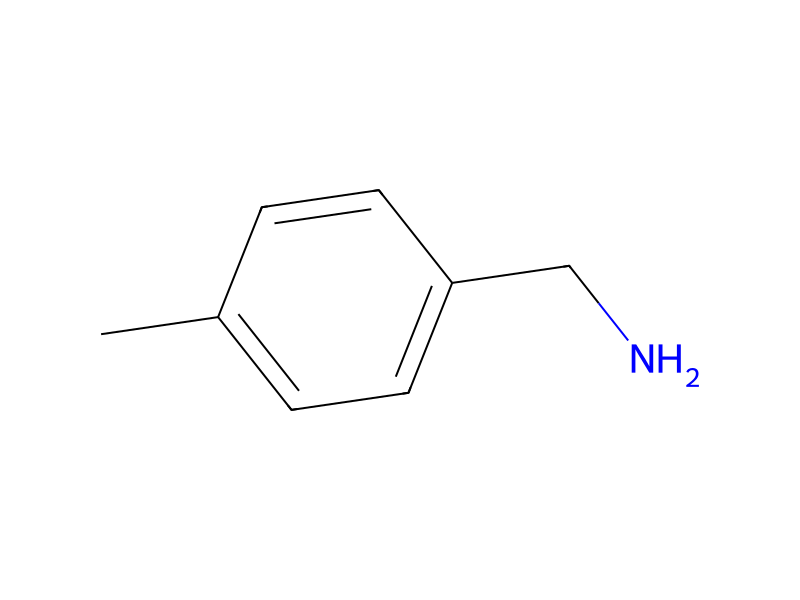
Ammonia → 4-Methylbenzylamine
Reaction equation

C(#N)C1C=CC=C(C#N)C=1.N.[C:12](#[N:21])[C:13]1[CH:20]=[CH:19][C:16]([C:17]#[N:18])=[CH:15][CH:14]=1>O1CCOCC1>[CH3:12][C:13]1[CH:20]=[CH:19][C:16]([CH2:17][NH2:18])=[CH:15][CH:14]=1.[C:13]1([CH2:12][NH2:21])[CH:20]=[CH:19][C:16]([CH2:17][NH2:18])=[CH:15][CH:14]=1Participants
6
Reactant 3


Product 2

Reagents, catalysts & solvents 1

Procedure
In place of 26.8 g of isophthalonitrile and 30 g of ammonia in Example 1, 24.6 g of terephthalonitrile, 52 g of dioxane and 25 g of ammonia were changed into the same autocLave and subjected to reaction in the same manner as in Example 1. It was found that the yield of 1,4-BAC was 88.2%, the yields of 4-methylbenzylamine and paraxylylenediamine were 7.2% and 2.1%, respectively, and that of other lower boiling and higher boiling products was 2.5%.
Workup
- customsubjected to reaction in the same manner as in Example 1
Sources & evidence
- ORD record
- ord-f89cee28588c4d19916440c58298a897
- Source dataset
- uspto-grants-1994_12
- Patent number
- US05371293
Reaction notes
Loading…