3-(2-Chloro-pyrimidin-4-yl)-benzaldehyde → 1-[3-(2-Chloro-pyrimidin-4-yl)-benzyl]-piperazine-2-carboxylic acid
Reaction equation

ClC1N=C(C2C=C(C=CC=2)C=O)C=CN=1.C(OC([N:23]1[CH2:28][CH2:27][N:26]([CH2:29][C:30]2[CH:35]=[CH:34][CH:33]=[C:32]([C:36]3[CH:41]=[CH:40][N:39]=[C:38]([Cl:42])[N:37]=3)[CH:31]=2)[CH:25]([C:43]([OH:45])=[O:44])[CH2:24]1)=O)(C)(C)C>>[Cl:42][C:38]1[N:37]=[C:36]([C:32]2[CH:31]=[C:30]([CH:35]=[CH:34][CH:33]=2)[CH2:29][N:26]2[CH2:27][CH2:28][NH:23][CH2:24][CH:25]2[C:43]([OH:45])=[O:44])[CH:41]=[CH:40][N:39]=1Participants
3
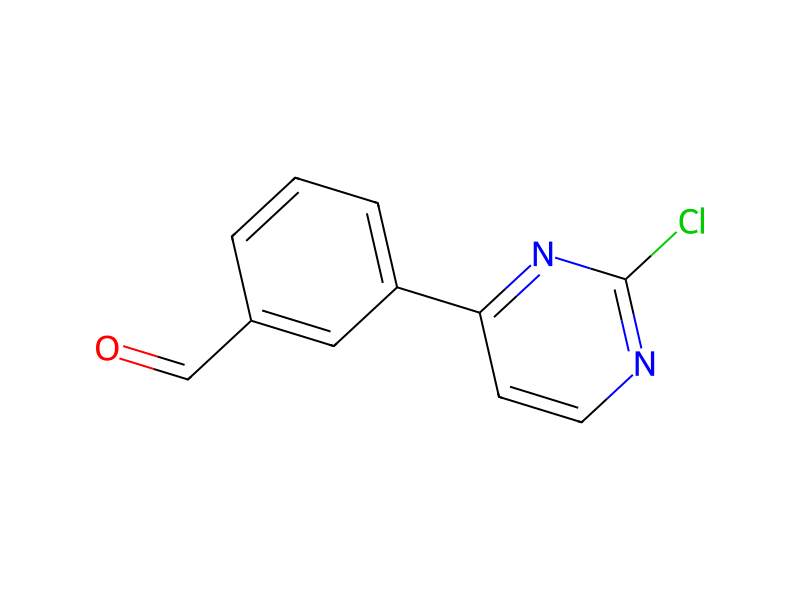


Procedure
Intermediate 1 was coupled with 4-[3-(2-chloro-pyrimidin-4-yl)-benzyl]-piperazine-1,3-dicarboxylic acid 1-tert-butyl ester following procedure B. LC-MS showed the product had the expected M+H+ of 433.
Sources & evidence
- ORD record
- ord-d17d4aabb9f444979c803e949533a344
- Source dataset
- uspto-grants-2010_06
- Patent number
- US07732444B2
Reaction notes
Loading…