2-Methylfuran → 5-(Hydroxymethyl)furfural
Reaction equation

CC1OC(C=O)=CC=1.CC1OC=CC=1.[OH:15][CH2:16][C:17]1[O:18][C:19]([CH2:22][OH:23])=[CH:20][CH:21]=1>>[OH:23][CH2:22][C:19]1[O:18][C:17]([CH:16]=[O:15])=[CH:21][CH:20]=1Participants


Procedure
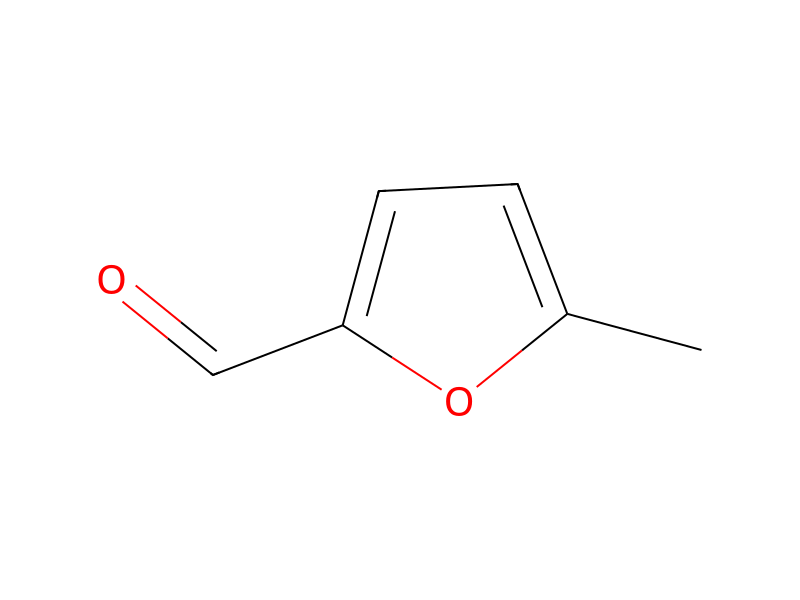
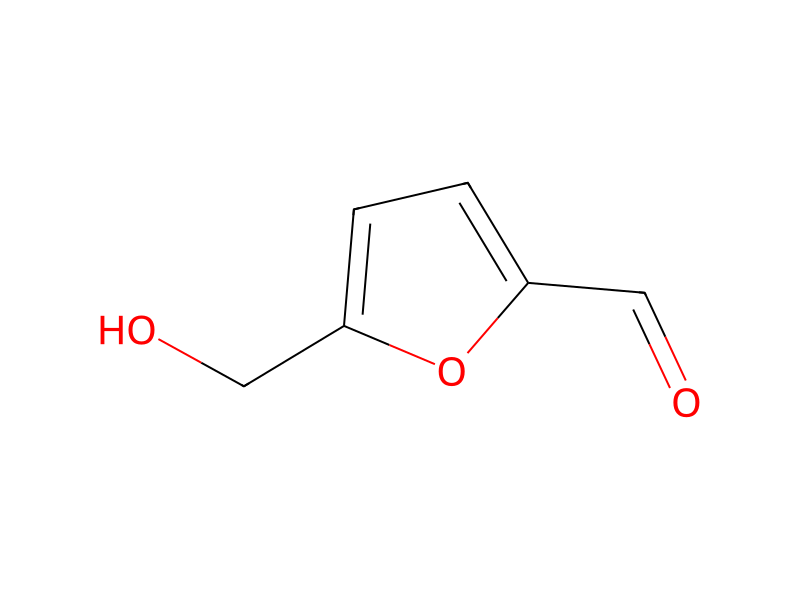
N-undecane has a boiling point of 196° C. so it can be considered as kerosene or light diesel. The boiling point of the final mix can be increased by introducing a branch, thus increasing the number of carbon atoms. For example the use of butanal together with 2-methylfuran can produce 6-propylundecane with a boiling point of approximately 225-230° C., which due to this property can be used as kerosene and diesel. In this case n-butanal would be obtained by oxidation of n-butanol which can also be a product derived from biomass. The number of carbons may be increased to 16 using 5-methyl furfural with 2 moles of 2-methylfuran. 5-Methyl furfural can be obtained from biomass by hydrogenation of an intermediate product from biomass (see for example Angew. Chem. Int. Ed. 2008, 47, 7924-7926). Another isomer with 16 carbon atoms can be obtained by using in the alkylation step two moles of 2-methylfuran and one mole of 2,5-di(hydroxymethyl)furan. The latter can be produced by selective hydrogenation of 5-hydroxymethylfurfural (HMF) that also comes from biomass.
Workup
- customAnother isomer with 16 carbon atoms can be obtained
Sources & evidence
- ORD record
- ord-b247373b26544158b4d5f5cfa4ac10fa
- Source dataset
- uspto-grants-2015_12
- Patent number
- US09199955B2
Reaction notes
Loading…