Dicyclohexylcarbodiimide → HCID 86625177, compound
Reaction equation

[OH:1][N:2]1[C:6](=[O:7])[CH2:5][CH2:4][C:3]1=[O:8].[Br:9][CH:10]([CH3:14])[C:11]([OH:13])=[O:12].C1(N=C=NC2CCCCC2)CCCCC1>C(Cl)Cl>[CH2:5]1[C:6](=[O:7])[N:2]([OH:1])[C:3](=[O:8])[CH2:4]1.[Br:9][CH:10]([CH3:14])[C:11]([O-:13])=[O:12]Participants
Reactant 3

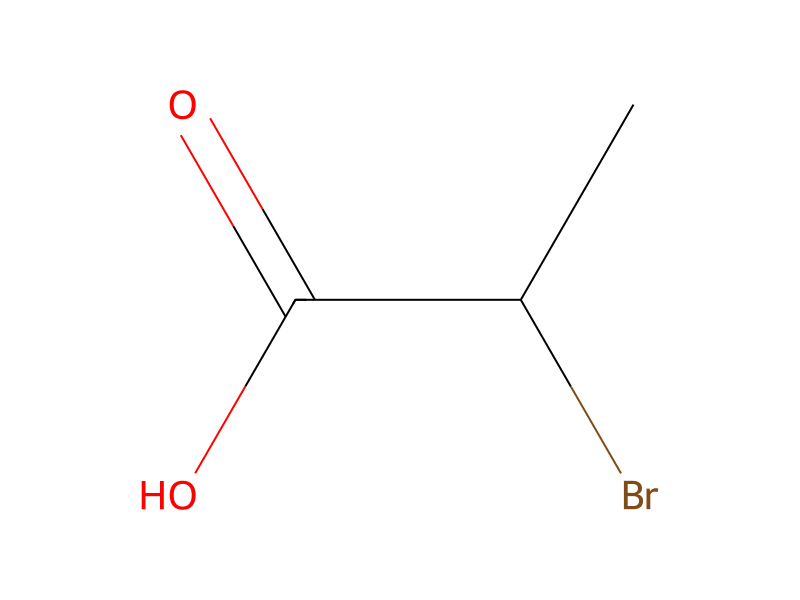

Product 1

Reagents, catalysts & solvents 1

Procedure
N-hydroxysuccinimide (4.51 g, 39.22 mmol) and 2-bromopropionic acid (2.9 mL, 32.68 mmol) were dissolved in anhydrous DCM (1000 ml) in a 2000 mL round-bottomed flask under nitrogen equipped with a magnetic stirrer. The flask was then cooled to 0° C. with an ice bath before the dropwise addition of a solution of N,N′-Dicyclohexylcarbodiimide (6.70 g, 32.68 mmol) in 50 mL of anhydrous DCM. After addition, the mixture was stirred at room temperature overnight. The reaction mixture was then filtered and the solvent evaporated to give a yellow solid that was purified by flash chromatography (CC, SiO2, Et2OO, Rf(ester)=0.31). Obtained 7.2 g (28.91 mmol, 74%) of product as a white solid. Melting point: 69-70° C. 1H NMR (CDCl3) δ (ppm) 1.96 (d, 3H, CH(CH)Br, J=6.78 Hz), 2.86 (s, 4H, Hcycl), 4.61 (q, 1H, CH(CH3)Br, J=7.03 Hz). 13C NMR (CDCl3) δ (ppm) 21.67 (1C, CH(CH3)Br) 25.74 (2C, Ccycl), 34.97 (1C, CH(CH3)Br), 166.17 (1C, C═O), 168.69 (2C, Ccycl═O). IR (solid, ATR cell) ν (cm−1) 1808, 1781 (Ccycl═O), 1729 (C═O). Mass spectroscopy (+EI, m/z) 248.964. Elem. Anal. Theoretical for C7H8NO4Br: C, 33.62; H, 3.22; N, 5.60. Found: C, 33.47; H, 3.16; N, 5.46.
Workup
- customequipped with a magnetic stirrer
- additionAfter addition
- filtrationThe reaction mixture was then filtered
- customthe solvent evaporated
- customto give a yellow solid
- customthat was purified by flash chromatography (CC, SiO2, Et2OO, Rf(ester)=0.31)
Sources & evidence
- ORD record
- ord-03ac755196eb424f94fa9b83338abca2
- Source dataset
- uspto-grants-2015_12
- Patent number
- US09200104B2
Reaction notes
Loading…