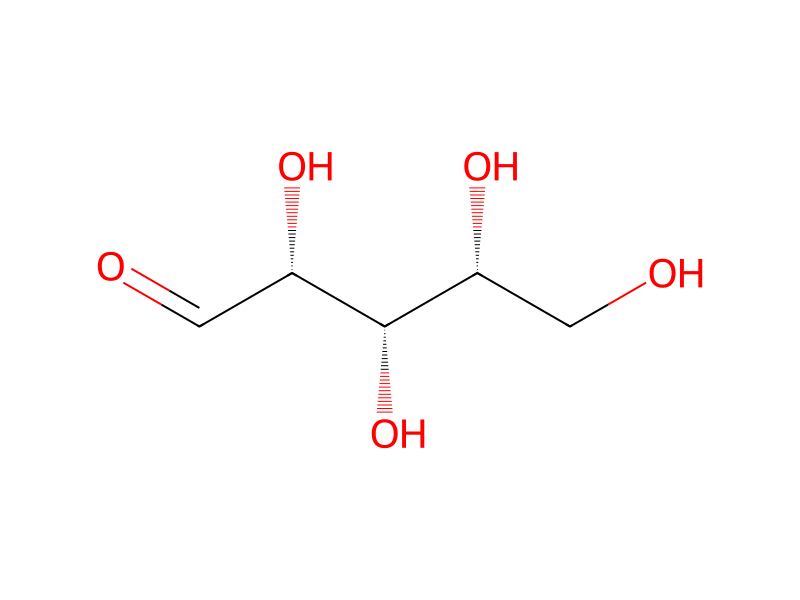
aldehydo-D-Xylose → (4S)-4,5-Dihydroxy-2-oxopentanoic acid
Reaktionsgleichung

[O:1]=[CH:2][C@@H:3]([C@H:5]([C@@H:7]([CH2:9][OH:10])[OH:8])[OH:6])[OH:4].[O:11]=[C:12]([OH:21])[C@@H:13]([C@H:15]([C@@H:17]([CH2:19][OH:20])[OH:18])[OH:16])[OH:14]>>[C:12]([OH:21])(=[O:11])[C:13]([CH2:15][C@@H:17]([CH2:19][OH:20])[OH:18])=[O:14].[O:11]=[C:12]([O-:21])[C@@H:13]([C@H:15]([C@@H:17]([CH2:19][OH:20])[OH:18])[OH:16])[OH:14].[O:1]=[C:2]([OH:11])[C@@H:3]([C@H:5]([C@@H:7]([CH2:9][OH:10])[OH:8])[OH:6])[OH:4]Komponenten


Versuchsvorschrift
Exemplary metabolites include D-xylose, D-xylonic acid, 3-deoxy-D-glycero-pentulosonic acid, 3,4-dihydroxy-D-butanal, 1,2,4-D-butanetriol, 4-hydroxy-D-butanal, and 1,4-butanediol. For example, as shown in FIG. 1, a recombinant microorganism can be metabolically engineered to provide elevated expression or heterologous expression of enzymes useful in the production of 1,4-butanediol. For example, xylose is converted to xylonic acid by a xylose dehydrogenase. 3-Deoxy-D-glycero-pentulosonic acid is produced by xylonate dehydratase from xylonic acid. 3-Deoxy-D-glycero-pentulosonoic acid is further converted by a decarboxylase to 3,4-dihydroxy-D-butanal. 3,4-Dihydroxy-D-butanal is then reduced to 1,2,4-D-butanetriol by a dehydrogenase. 1,2,4-D-butanetriol is further dehydrated into 4-hydroxy-D-butanal by a dehydratase. 4-hydroxy-D-butanal was then reduced to 1,4-butanediol by a dehydrogenase.
Quellen und Nachweise
- ORD-Eintrag
- ord-45920c0c463841c09f828b9287149881
- Quelldatensatz
- uspto-grants-2015_12
- Patentnummer
- US09200288B2
Notizen zur Reaktion
Wird geladen…