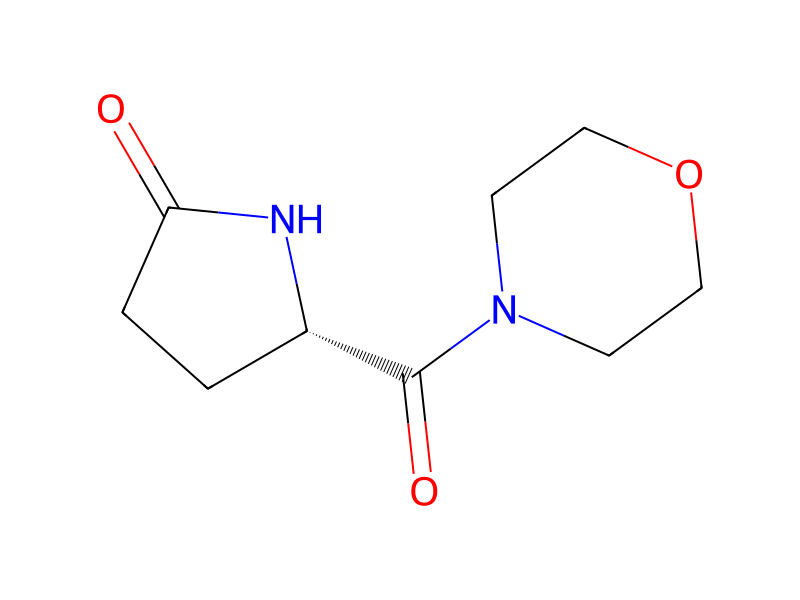
L-Pyroglutamic Acid → (S)-4-((5-Oxo-2-pyrrolidinyl)carbonyl)morpholine
Reaction equation

C1(N=C=NC2CCCCC2)CCCCC1.[NH:16]1[C:20](=[O:21])[CH2:19][CH2:18][C@H:17]1[C:22]([OH:24])=O.OC1C2N=NNC=2C=CC=1.[NH:35]1[CH2:40][CH2:39][O:38][CH2:37][CH2:36]1>ClCCl>[N:35]1([C:22]([C@H:17]2[NH:16][C:20](=[O:21])[CH2:19][CH2:18]2)=[O:24])[CH2:40][CH2:39][O:38][CH2:37][CH2:36]1Participants
6





Procedure
To a mixture of 48 g dicyclohexylcarbodiimide, 30 g commercially available L-pyroglutamic acid and 3.1 g hydroxybenzotriazole 20.2 g of morpholine were added in 170 ml dichloromethane at about −15° C. The mixture was allowed to warm to room temperature. The suspension was filtered and diluted with 290 ml THF. The mixture was concentrated to obtain a suspension, which was filtered yielding 41 g of (S)-5-(morpholine-4-carbonyl)pyrrolidin-2-one.
Workup
- filtrationThe suspension was filtered
- additiondiluted with 290 ml THF
- concentrationThe mixture was concentrated
- customto obtain a suspension, which
- filtrationwas filtered
Sources & evidence
- ORD record
- ord-f2c13aa6128846a8bc2ad668962d51c2
- Source dataset
- uspto-grants-2015_12
- Patent number
- US09206116B2
Reaction notes
Loading…